If you’ve ever tried to get comfortable in a clinic waiting room at 32 weeks, you’ll understand why more expecting Canadians are choosing at-home care. Prenatal massage techniques, applied correctly and adapted to each stage of gestation, can offer real physical relief from the persistent lower back ache that sets in during the first trimester to the hip and leg heaviness that builds through the third.
But prenatal massage is not a softened version of standard soft-tissue work. It is a discipline in its own right, with specific demands around positioning, pressure calibration, contraindication screening and ongoing clinical adaptation.
Whether you’re a massage therapist building your skills in this area or an expecting parent who wants to understand what a skilled, professional provider should actually be doing in the room, this guide covers the foundations that count.
You’ll find practical guidance on bolstering and side-lying positioning, how pressure shifts across each trimester, which contraindications are absolute, and how to run a thorough pre-session intake. Understanding these prenatal massage techniques helps both providers and clients get the most from every session safely and consistently.
This article is general educational content for practitioners and informed clients. It does not replace formal training, clinical supervision or medical advice specific to your pregnancy.
How Positioning And Bolstering Create A Safe Foundation
Positioning is where most of the technical complexity in prenatal massage begins. The standard prone position lying face down becomes inappropriate well before the third trimester. From around 12 to 16 weeks, depending on individual body type and uterine growth, prone positioning places direct pressure on the abdomen and can compress the inferior vena cava, limiting venous return to the heart.
When working with clients at home rather than in a clinic, bringing your own professional bolstering equipment to every session is what makes a proper clinical setup possible regardless of what furniture or pillows happen to be available. This equipment consistency is worth building into your own kit as a standard, not an afterthought.
Side-Lying As The Default From The Second Trimester
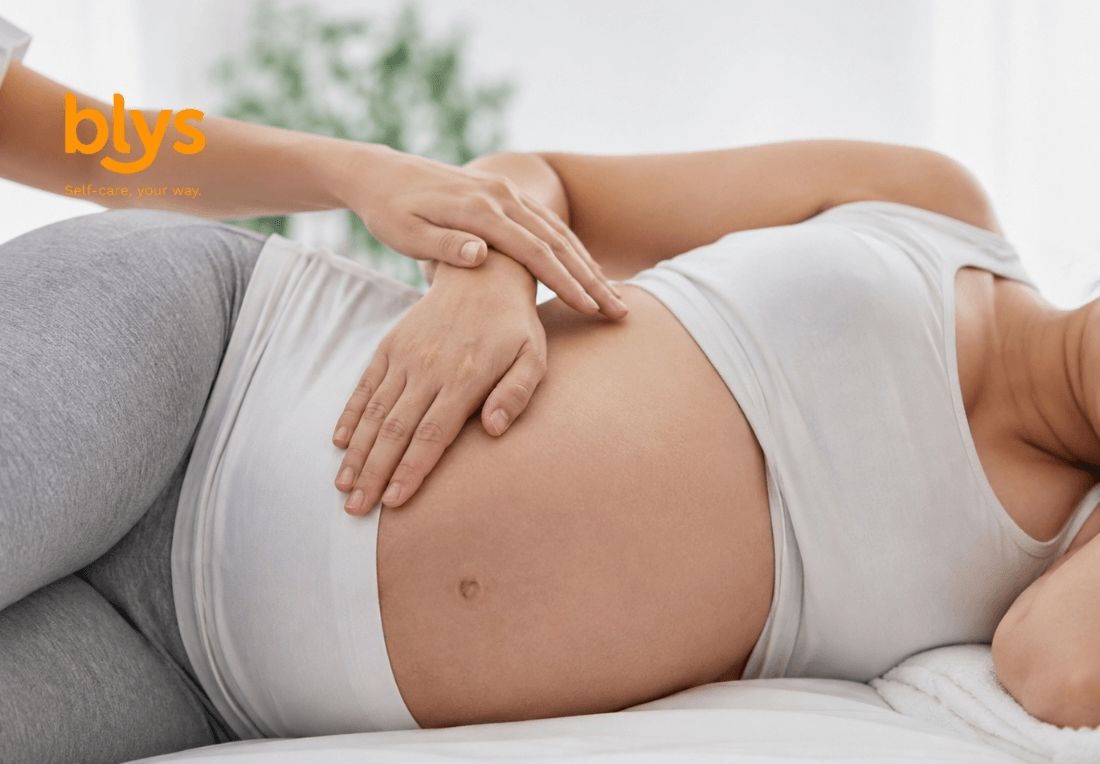
Side-lying (lateral recumbent) is the most widely used and safest position for prenatal massage from the second trimester onward. With the client resting on their left side which supports optimal venous circulation back to the heart the upper leg is brought forward and supported by a firm bolster or full-length body pillow. The head and upper shoulder are also supported to maintain a neutral cervical and thoracic spine.
A well-bolstered side-lying setup typically requires:
- A full-length body pillow or wedge beneath the upper knee and lower leg
- Adequate head and neck support to keep the cervical spine aligned
- A small supportive pillow under the abdomen if the client finds this comfortable
The goal is to remove torsional load and compression from the spine and pelvis, allowing the client to relax without compensating through their posture.
Semi-Reclined And Seated Variations
Some providers use a semi-reclined position at approximately 45 degrees, supported by a wedge cushion or stacked pillows. This is practical in later pregnancy when full side-lying becomes uncomfortable due to pelvic girdle pressure, or for clients managing reflux. A seated position upright in a chair or leaning forward onto support works well for upper back, shoulder and neck work at any stage.
Prone positioning using a purpose-built pregnancy cushion with an abdominal cutout is used by some practitioners but remains professionally contested. Clinical opinion is divided, particularly in later trimesters or with any identified risk factors. Most providers working conservatively avoid prone positioning after the first trimester.
How Does Pressure Need To Change Across Each Trimester?
Pressure calibration is one of the most important prenatal massage techniques to apply correctly. The physical demands and sensitivities of the body shift considerably across all three trimesters, and applying a uniform pressure approach throughout does not serve the client well at any stage.
First Trimester
The first trimester calls for a conservative, attentive approach. Prenatal massage is not contraindicated in healthy, uncomplicated pregnancies, but experienced providers typically work with lighter, more general strokes during weeks one through twelve.
This reflects both the heightened nervous system sensitivity many clients report in early pregnancy and the elevated risk of miscarriage during this period not a direct contraindication, but a sound clinical and ethical reason to proceed carefully. Deep abdominal work should be avoided entirely. Ongoing verbal check-ins during the session are essential.
Second Trimester: The Most Effective Window
The second trimester is generally the most effective period for applying prenatal massage techniques, and the stage where clients most often report the greatest benefit. The uterus has risen above the pelvis, morning sickness typically subsides, and the mechanical load on the lower back and hips has increased enough that moderate, focused work is both clinically appropriate and well-received.
Effleurage and petrissage adapted for side-lying are effective across the lumbar and gluteal regions. The sacroiliac joint is a common site of discomfort as the pelvis accommodates the growing uterus sustained, moderate pressure in this area can offer significant relief for many clients.
Third Trimester: Moderation And Attentiveness
By the third trimester, pressure should again be moderated and the clinical focus shifts. The body is under considerable structural strain and circulation is more complex. Sustained deep pressure on the lower limbs is not appropriate the risk of deep vein thrombosis (DVT) is elevated during pregnancy, particularly in this trimester.
Light to moderate effleurage on the lower limbs is generally appropriate in healthy, low-risk pregnancies, but any signs of significant oedema, localized heat, redness or asymmetrical swelling in the legs warrant referral, not continued work.
Absolute Contraindications Every Provider Must Screen For
No level of technical skill makes prenatal massage appropriate when absolute contraindications are present. The following require that a session either does not proceed or has explicit medical clearance before beginning:
- Pre-eclampsia or pregnancy-induced hypertension.
- Deep vein thrombosis or known clotting disorders.
- Placenta praevia or unexplained vaginal bleeding.
- Premature labor or preterm rupture of membranes.
- Severe oedema in the hands, face or feet (a potential pre-eclampsia indicator).
- Active infection, fever or systemic illness.
- High-risk pregnancy designation from a family doctor, OB-GYN or midwife.
Practitioners should also note that certain acupressure points including SP6 (Spleen 6, approximately four finger-widths above the medial malleolus) and LI4 (Hegu, in the webbing between thumb and index finger) are traditionally contraindicated in pregnancy due to their reputed uterine-stimulating properties.
The clinical evidence is mixed, but most providers working conservatively avoid these points throughout pregnancy as a precautionary measure.
For an accessible overview of safety from a client’s perspective, the article on whether prenatal massage is safe covers these questions clearly. Health Canada’s information on complementary health approaches during pregnancy is a reliable reference for practitioners and clients seeking authoritative clinical guidance.
Why Prenatal Massage Technique Needs To Evolve Session By Session
One of the most common gaps in practice is treating prenatal massage as a fixed protocol applied uniformly at every visit. The reality is that positioning, pressure, focus areas and session duration all need to evolve as the pregnancy advances sometimes week to week.
In the early weeks, a client may be comfortable in a semi-reclined supine position. By 28 to 32 weeks, that same position may be intolerable. A provider who isn’t updating their intake and approach to reflect where a client currently sits in their pregnancy is working with incomplete information and the quality of care reflects that.
Key areas to reassess at every session:
- Current positioning tolerance and bolster requirements.
- New or shifting symptoms sciatic referral, pubic symphysis dysfunction, rib flare, carpal tunnel.
- Any updates in pregnancy status: new diagnoses, medication changes, or instructions from a family doctor or midwife.
Working with clients at home also offers a practical clinical advantage over clinic-based care. Without a commute or a waiting room between a client and the session, clients are more likely to attend consistently, which means you’re able to track changes week by week and adapt your approach accordingly. That continuity directly supports better, more responsive care across the full pregnancy, and it’s one of the underappreciated advantages of building a mobile practice.
Clients are far more likely to attend consistently which means the provider can track changes week by week and adapt their prenatal massage technique accordingly. That continuity directly supports better, more responsive care across the full pregnancy.
Research accessible through PubMed has explored associations between prenatal massage and reductions in anxiety, cortisol and physical discomfort. These outcomes depend on skilled, appropriate application not prenatal massage in isolation. For more on the evidence, the article on prenatal massage benefits explores the research in accessible terms.
What To Cover With Your Client Before The Session Begins
A thorough pre-session intake is not optional in prenatal massage it is part of the clinical technique. It should be adapted specifically for pregnant clients and reviewed at every visit, not just the first session.
- Obstetric history and current pregnancy status: How many weeks along? Singleton or multiple pregnancy? Any known complications, high-risk designations or specialist referrals? Has a family doctor, OB-GYN or midwife been informed the client is receiving prenatal massage?
- Current symptoms: Where is the discomfort? Is there lower limb swelling, numbness or tingling? Any recent onset of pelvic girdle pain? Has the client experienced headaches, visual disturbances or upper abdominal pain all of which require medical assessment before the session proceeds?
- Positioning and comfort history: Has the client received prenatal massage before? Do they have any positioning preferences, or previous experience of discomfort on the table?
- Post-session expectations: Prenatal massage can cause temporary fatigue or a mild emotional response in some clients. Giving clear guidance on what to expect and when to follow up if anything feels unusual is part of responsible professional practice.
For clients thinking ahead to the postpartum period, the guide on when you can get a massage after giving birth is a useful resource to share at the right time.
Ready To Book Prenatal Massage At Home In Canada?
Prenatal massage techniques are precise, adaptive, and specific to each client’s stage of pregnancy. Getting positioning, pressure calibration, and contraindication screening right isn’t an optional refinement. It’s the foundation of safe, effective practice.
For therapists looking to build this specialty into their own work, Blys connects qualified providers with expecting clients across Canada actively looking for this kind of skilled, at-home care. Sign up as a provider to start offering pregnancy massage sessions.