The market for trigger point massage tools is enormous, which reflects how many people have a knot they cannot reach and enough disposable income to buy something that promises to fix it. Some of these tools work well. Some work partially. A few are solving a problem that does not exist. This is an honest guide to which devices actually help release muscle knots, what each one does, and what to expect before spending money on any of them.
Massage Balls: The Most Useful Tool for Most People
If you own one trigger point massage tool and want it to actually do something, the best trigger point tools list always starts with a massage ball. It is cheap, requires no power, works on most of the body’s accessible trigger point locations, and does exactly what trigger point release requires: concentrated, firm, held pressure on a single spot.
How a Massage Ball Works
You place the ball between your body and a firm surface, a wall for the upper back and shoulders or the floor for the glutes and hips, and use your body weight to control how much pressure you apply. Unlike a foam roller, which distributes contact across a broad area, the ball concentrates all of that pressure into one spot, which is what trigger point release actually needs.
The technique is simple: find the tender spot, position the ball on it, and stay there. Do not roll around. The impulse to keep moving is almost universal and almost always counterproductive. For more on the technique behind this, the trigger point self-massage guide covers how to find the right spot and how long to hold it. The release happens from holding the pressure, not from searching for new spots with it.
Which Ball to Use
A standard tennis ball is a good starting point: firm enough to reach most surface muscles, soft enough that you are not grinding bone against the floor. A trigger point massage ball does not need to be complicated. For deeper muscles like the piriformis or the QL, a lacrosse ball or a harder rubber ball provides more penetration. For the suboccipitals at the base of the skull, two tennis balls in a sock placed side by side give a surface that supports the neck without compressing the spine.
Do not buy an expensive “trigger point ball” that is functionally identical to a lacrosse ball but costs four times as much. The ball does not know what it costs.
The Theracane: The Tool for Spots You Cannot Reach
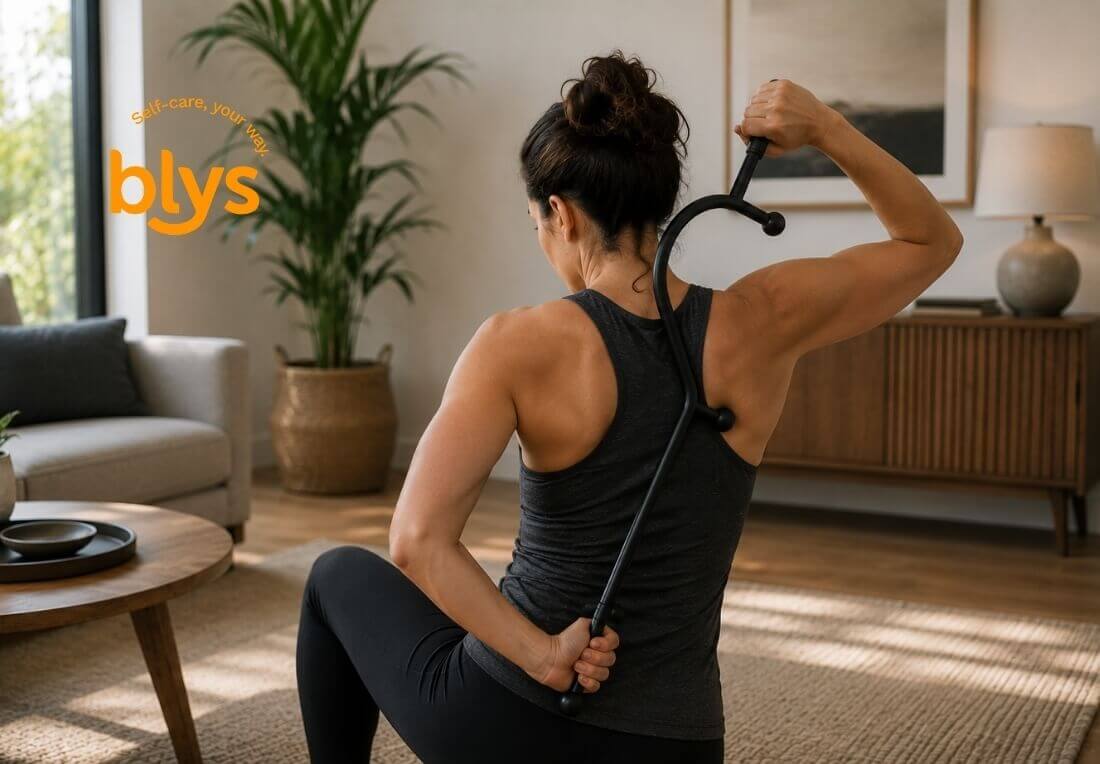
The Theracane trigger point tool (and similar S-shaped hook devices) exists specifically to solve the problem that massage balls cannot: reaching the muscles between the shoulder blades, the mid-back, and other areas where positioning against a wall or floor does not work.
What the Theracane Does
It is a rigid hook with a ball at one end that allows you to apply focused pressure to spots on your back by pulling the handle rather than pushing your body weight into a surface. The design looks strange and works well, which is a combination that describes most actually useful tools in the world.
The technique is the same as with a ball: find the tender spot, apply the pressure, hold it. The theracane gives you reach that your hands do not have and control that a ball on the floor does not offer. For the rhomboids, mid-trapezius, and paraspinal muscles, the ones most people describe as “that spot between my shoulder blades I can never quite get to,” it is the best self-massage option available.
What It Does Not Do
It does not reach the piriformis. It does not work on the suboccipitals. And it requires a learning curve before you can use it effectively, because the hand position and the angle of pull that produce effective pressure take a few sessions to work out. Most people who buy one and give up after a week did not use it long enough to learn it.
Foam Rollers: Good for Muscles, Not for Trigger Points
Foam rollers and trigger point rollers are the most popular recovery tools in most gyms, and they are excellent at what they are designed to do: reducing general muscle soreness, improving circulation, and loosening up broad areas of muscle before or after training. What they are not excellent at is trigger point release, and the two are often confused.
Why a Foam Roller Does Not Release Trigger Points
A trigger point release requires concentrated pressure on a single, specific spot held for long enough that the muscle responds. A foam roller distributes contact across a broad area and is almost always used in a rolling motion, which provides neither the concentration nor the hold that trigger point work needs. Rolling across a knot is not the same as pressing into it.
Foam rolling the upper back, the IT band, and the calves is a reasonable part of a recovery routine. Expecting it to release the piriformis trigger point that has been causing your hip pain for eight months is setting it up to fail.
Where a Foam Roller Is Actually Useful
For general muscle maintenance, pre- and post-exercise soreness, and broad tissue mobilization, a foam roller has a place. It is a useful complement to trigger point work, not a substitute for it. Using one before a session loosens the surface tissue and may make the deeper trigger point work more effective. Using one instead of a session is why a lot of people make slower progress than they expect.
Massage Guns: Fast, Noisy, and Useful in the Right Circumstances
Massage guns have gone from professional sports equipment to impulse purchase in about four years, which means there are now a lot of them in drawers next to the foam roller that “did not really work.” The technology is real. The question is whether it is the right tool for what you are trying to do.
What a Massage Gun Does Well
Percussive therapy, which is what massage guns deliver, increases blood flow, reduces muscle stiffness, and improves range of motion when used before activity. It is most effective for large muscle groups: the quads, hamstrings, glutes, and upper back, and it is faster than foam rolling for covering broad areas. For general recovery and warm-up, it earns its place.
For trigger point release specifically, the evidence is less clear. The rapid percussion does not replicate the firm, held pressure that releases a trigger point. It does reduce the surrounding muscle tension, which can make trigger points easier to locate and may reduce how reactive they are, but it is a preparation tool for trigger point work rather than a trigger point tool itself.
What to Look For in a Massage Gun
The attachment head matters more than the speed settings. A small, rounded head concentrates contact for more specific work. A large, flat head covers broad areas more evenly. Most massage guns come with several attachments that most people never try. Try them.
If you are spending more than two hundred dollars on a massage gun, make sure you are doing it because you actually need the quality rather than because the marketing is convincing. The core technology does not vary as much between price points as the advertising suggests.
Which Tools Are Worth Buying
Here is the honest summary, without the accessories marketing:
- A massage ball or lacrosse ball: buy one. It costs almost nothing and works for most accessible trigger points. Start here.
- A Theracane or similar hook tool: worth buying if mid-back and inter-scapular muscles are your main issue and a ball on the wall does not reach them.
- A foam roller: useful for general recovery, not for trigger point release. If you already have one, keep it. If you do not, it is not the first thing to buy for knot relief.
- A massage gun: useful if you are training regularly and want faster warm-up and recovery. Not a trigger point tool but a useful complement to one.
What none of these tools replicate is a trained therapist locating the exact trigger point, applying the right pressure, and holding it for the length of time that particular point needs. Between sessions, the tools earn their place. However, the session is still the main event.
When the tools have done what they can, book a trigger point massage at home through Blys, available 7 days a week, 6 am to midnight across Canada.