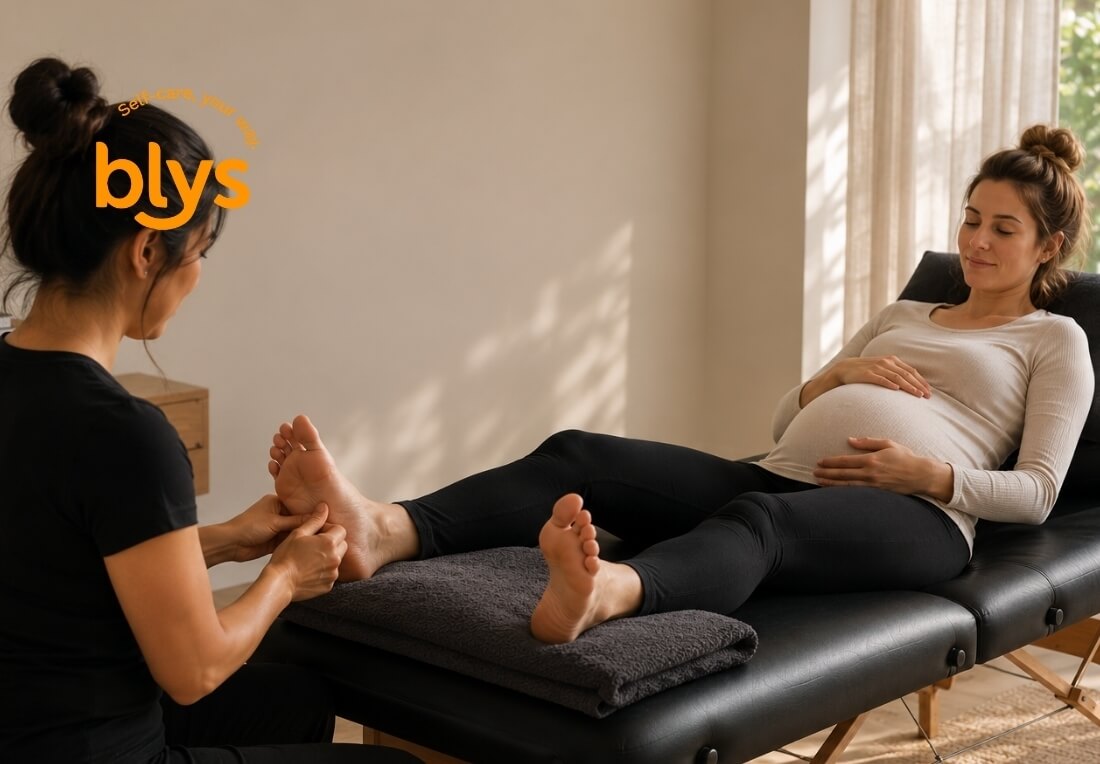
Pregnancy involves a fairly comprehensive list of things your body does without asking permission, and the standard advice for most of them is to rest, stay hydrated, and wait. Reflexology for pregnancy offers something slightly more active: a therapy that addresses several of the most common pregnancy complaints through the feet, without requiring any pressure on the abdomen, any positions that are uncomfortable at 28 weeks, or any treatment that interferes with what the body is already doing on its own.
It also happens to be one of the more unusual things reflexology is used for, given that most people associate it with stress and sleep rather than swollen ankles and morning sickness.
The honest answer to whether reflexology is safe during pregnancy is: yes, with some important qualifications, and those qualifications matter enough to go through properly before booking anything.
Is Reflexology Safe During Pregnancy?
For most pregnancies, reflexology is considered safe when performed by a therapist trained in pregnancy reflexology, at the right time in the pregnancy, and with the appropriate modifications to the points worked. That sentence contains three conditions, and all three are worth understanding.
Why Therapist Training Matters More for Pregnancy Reflexology
A standard reflexology session and a pregnancy reflexology session are not the same thing. Certain reflex points, including the uterus and ovary points on the inner and outer ankle, the pelvic points in the heel, and specific points associated with stimulating labour, are avoided or worked very lightly during pregnancy, especially in the first trimester and again near the due date. A therapist without specific pregnancy reflexology training may not know which these are, or may not have the experience to apply the right level of pressure across the session as a whole.
Before booking, it is worth checking that the therapist has specific pregnancy reflexology training and experience, not just general reflexology training with a note in the booking that you are pregnant.
Reflexology in the First Trimester
The first trimester is when most reflexology practitioners and pregnancy guidelines are most cautious. The first twelve weeks carry the highest risk of miscarriage, and while there is no strong evidence that reflexology causes miscarriage, there is also not enough research to rule out any contribution from stimulating certain reflex points during this period.
Many practitioners will not offer reflexology in the first trimester at all. Some will offer a very light session focused on relaxation and stress reduction without working the points most closely associated with the reproductive and pelvic zones. If you are in your first trimester and considering reflexology, the conversation to have first is with your midwife or General Practitioner, not with a booking platform.
Second and Third Trimester
From the second trimester onward, pregnancy reflexology is much more widely offered and generally well-tolerated. The session is modified compared to a standard reflexology treatment, with the ankle, heel, and pelvic zone points worked very lightly or avoided, and the focus shifting toward the points most useful for the specific complaints that pregnancy produces.
Most women who try reflexology during the second or third trimester are not there because they believe in zone therapy. They are there because their back hurts, they cannot sleep, they have had heartburn for three months, and they are prepared to try having their feet worked on if there is a reasonable chance it helps. There is.
Pregnancy Reflexology Benefits: What It Can Help With
Nausea and Morning Sickness
The stomach and digestive reflexes in the arch of the foot, combined with the solar plexus point and the adrenal reflex, are the points most commonly worked for nausea relief in pregnancy. Several small studies have found reflexology reduces the frequency and severity of nausea in pregnant women, and the anecdotal evidence from practitioners is very consistent in the same direction.
Nausea that is severe or persistent, hyperemesis gravidarum specifically, needs medical management rather than reflexology. For the garden-variety morning sickness that comes in waves and is annoying rather than dangerous, reflexology is a reasonable tool to have available.
Back Pain and Pelvic Discomfort
The spine reflex runs down the inner edge of the foot and maps to the full length of the spine, including the lower back and sacrum where most pregnancy-related back pain originates. It is one of the most worked zones in the foot reflexology pressure points guide for a reason. Working this reflex does not replace physiotherapy or specific pregnancy exercises, but it consistently produces a response that clients describe as relief in that area, which, given that the alternative is paracetamol and a heat pack, is not a small thing.
The key caution is that the pelvic and sacral points in the heel zone are worked very carefully in pregnancy, especially in the later stages, to avoid stimulating points that could theoretically encourage early labour.
Swollen Ankles and Fluid Retention
Oedema, the swelling in the feet, ankles, and legs that arrives uninvited in the second trimester, is one of the most common complaints in the second and third trimesters. The lymphatic and kidney reflexes on the foot are the primary zones for fluid regulation, and working them as part of a pregnancy reflexology session at home is one of the more reliably effective applications of the therapy during pregnancy. Most women notice a reduction in ankle swelling after a session, which is welcome news for anyone who has spent three months watching their feet disappear.
Sleep and Anxiety
The solar plexus point, the diaphragm reflex, and the adrenal gland points are the zones most closely associated with sleep and stress response, and they are all safe to work during pregnancy. For pregnancy-related anxiety, which is common and often under-addressed, reflexology offers a body-based approach that works on the nervous system without medication or anything that requires sitting still and trying to meditate for twenty minutes when your brain has decided that 2am is an excellent time to think about everything.
Reflexology Points to Avoid During Pregnancy
This section exists because knowing which points are avoided is as useful as knowing which ones are worked. A competent pregnancy reflexologist will manage this automatically, but it is worth knowing what they are managing.
The points most consistently identified as needing caution or avoidance during pregnancy are:
- The uterus reflex on the inner ankle
- The ovary reflex on the outer ankle
- The pelvic floor points in the heel
- Specific points associated with stimulating uterine contractions, sometimes called the labour-inducing points, which sit in the heel and ankle zone
- The upper cervical spine points near the base of the big toe, worked very lightly in early pregnancy
None of these are touched aggressively during a well-managed pregnancy reflexology session. The ankle points in particular are areas that a standard reflexology session would work quite specifically, and a pregnancy session leaves them largely alone until the final weeks when some practitioners use light work on these points as part of a pre-labour preparation session, but only after 37 weeks, only with obstetric clearance, and only with a therapist specifically trained in this application.
What to Look for in a Pregnancy Reflexologist
Specific Training
Look for a therapist who has completed specific training in pregnancy reflexology, not just general reflexology with an interest in prenatal care. The two are different skill sets, and the difference matters more during pregnancy than it does for most other applications.
When to Check With Your Doctor First
Reflexology during pregnancy is generally safe for low-risk pregnancies from the second trimester. It requires a conversation with your General Practitioner or midwife first if you have a high-risk pregnancy, a history of preterm labour, placenta praevia, pre-eclampsia, or any condition that your care team is actively monitoring.
This is not a reflexology-specific caution. It applies to most complementary therapies during pregnancy, and it is worth treating it as a routine check rather than a reason to assume the answer will be no.
For broader pregnancy wellness support, prenatal massage is another option that works well alongside reflexology during the second and third trimesters, and postnatal massage in the weeks after birth is worth planning for at the same time you are booking reflexology sessions.
The back pain, the swollen ankles, and the 2am anxiety spiral are all still going to be there next week. A session now is just one fewer week of dealing with them alone.
Book a reflexology session at home through Blys, available 7 days a week, 6 am to midnight across Canada. Check with your midwife first, then book.