Sciatica has a talent for being exactly as bad as you think it is going to be, and then slightly worse. The sharp, radiating pain that shoots from the lower back down through the buttock and into the leg is one of those experiences that is hard to explain to someone who has not had it and impossible to forget once you have. The good news is that a large proportion of sciatica cases are not coming from the sciatic nerve itself. They are coming from trigger points in the surrounding muscles, tight irritable spots that refer pain along the nerve’s path and mimic sciatic nerve compression almost perfectly.
This matters because trigger point massage sciatica treatment addresses the actual source of pain in these cases, rather than the nerve the pain is travelling through.
What Causes Sciatic Pain and Why Trigger Points Are Often Involved
The sciatic nerve is the longest nerve in the body, running from the lower back through the buttock and down the back of the leg. When it is compressed by a herniated disc, bone spur, or narrowing of the spinal canal, the result is true sciatica, which requires medical management.
The Difference Between True Sciatica and Referred Pain
What most people call sciatica is often something slightly different. Trigger points in the piriformis, gluteus medius, gluteus minimus, and lower back muscles can produce referred pain that travels down the leg in almost exactly the same path as true sciatic nerve compression. The pain is real, the picture is convincing, and the relief available through focused massage is considerably better than what most people expect when they first hear that their nerve might not be involved at all.
True sciatica requires a General Practitioner (GP) or physiotherapist’s assessment before any massage treatment. Referred pain from muscular trigger points responds well to massage, often dramatically and quickly. Knowing which one you are dealing with matters, and if you have not already had a proper assessment, that is the right starting point before anything else.
What a Trigger Point Actually Is
A trigger point is a tight, irritable spot within a muscle that is under continuous low-level contraction. It hurts when pressed, and it refers pain to a predictable location away from where it actually is. The piriformis trigger point, for example, refers pain into the buttock and down the back of the leg in a path almost identical to sciatic nerve compression. The gluteus medius and minimus trigger points refer pain further into the hip and outer thigh.
The muscle is not just sore. It is stuck in a state of partial contraction that it has lost the ability to release on its own, and firm, focused pressure from a trained therapist is one of the more reliable ways to reset it.
Sciatica Trigger Points: Which Muscles Are Involved
The Piriformis: The Main Suspect
The piriformis sits deep in the buttock, running from the sacrum to the top of the femur, and it is the muscle most commonly involved in trigger point-related sciatic pain. When the piriformis is tight or in spasm, it can compress the sciatic nerve itself (a condition called piriformis syndrome), or it can simply refer pain along the nerve’s path through its own trigger points.
The piriformis is tricky to reach with standard massage because of its depth. A therapist working piriformis trigger points needs to go through the gluteal muscle layer to find it, which needs both the right technique and the right positioning. This is not a muscle that responds well to self-massage with a foam roller, which is worth knowing before spending six weeks trying.
Gluteus Medius and Minimus: The Overlooked Ones
The gluteus medius and minimus sit on the side and back of the hip, and their trigger points are frequently overlooked in people presenting with lower back and leg pain. These muscles refer pain into the lower back, buttock, and outer hip in ways that vary enough to confuse the picture, and they are often simultaneously tight in people who also have piriformis involvement.
Working these muscles as part of a session focused on sciatica trigger points produces results that address the wider spread of pain rather than just the most acute spot, which is why good trigger point therapy for sciatica covers the whole posterior chain rather than just pressing the single most tender spot.
Lower Back Muscles: Quadratus Lumborum and Erector Spinae
The quadratus lumborum, usually called the QL because nobody can remember its actual name on command, sits at the back of the abdomen between the lower ribs and the pelvis. Its trigger points refer pain into the lower back, sacral area, and hip, often mimicking the deep aching part of sciatica. The erector spinae muscles running alongside the spine refer pain into the lower back in the more familiar way that most people describe as just “back pain.”
Both muscle groups are frequently involved in lower back pain that accompanies sciatica, and addressing them as part of a full trigger point session gives more complete relief than working the gluteal area alone.
How to Massage Sciatica Trigger Points: What a Session Involves
What Trigger Point Therapy Actually Does
Trigger point therapy applies firm, focused pressure to the trigger point, the specific tight spot within the muscle, and holds it there until the muscle releases. This is different from general massage, which works across the whole muscle in strokes. Trigger point work is more specific, and requires the therapist to locate the exact point rather than working the general area.
The pressure is held for long enough to allow the muscle to respond, which typically takes between 8 and 90 seconds depending on how long the point has been active. Most people describe the sensation as a dull, intense ache at the point of pressure combined with the referred sensation they recognize from their usual symptoms, followed by a release. The referred pain reducing during the pressure hold is one of the clearest signs the right point has been found.
What a Session for Sciatic Pain Looks Like
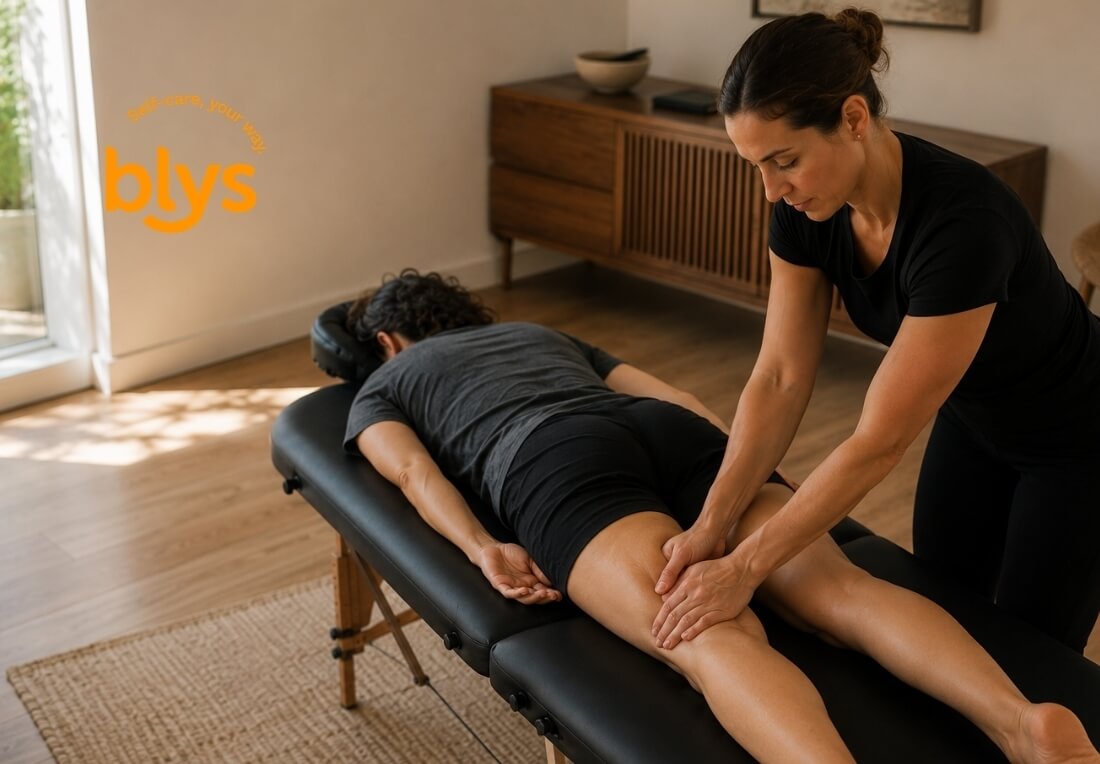
A session targeting sciatica trigger points covers the piriformis and gluteal muscles, the QL and lower back muscles, and often the hip flexors, which are frequently tight in people with lower back pain and can feed into the overall problem. The session is typically done with the client lying face down, with the therapist working through the gluteal layer to reach the deeper muscles.
Sessions run for 60 to 90 minutes to allow enough time to work through the full posterior chain rather than just the most symptomatic area. A mobile massage session at home is well suited to sciatica treatment because lying on a proper massage table for 90 minutes is considerably more comfortable than most alternatives, and the post-session period, when the body needs to settle rather than immediately get in a car, is easier to manage at home.
What to Tell Your Therapist Before the Session
The more specific you can be about your pain picture, the more specific the session can be. Where the pain starts, where it goes, what makes it worse, whether it is constant or comes in waves, and whether you have had any imaging or assessment are all useful information. If you have a confirmed disc herniation or spinal stenosis, tell the therapist before the session so they can adjust the pressure and positioning to suit.
Trigger Point Massage for Back Pain: What to Avoid
Deep Pressure on an Actively Inflamed Nerve
If the sciatic nerve itself is inflamed, which is more likely in the acute phase of an episode and especially if there is numbness or tingling in the leg alongside the pain, deep pressure work over the nerve is not appropriate. A trained therapist will avoid this automatically, but it is worth knowing so you do not interpret careful technique as insufficient effort.
Foam Rolling the Piriformis
Foam rolling the IT band and outer hip is common advice for hip pain, and it misses the piriformis almost entirely while potentially making the surrounding muscles more irritated. Direct piriformis work requires the kind of focused, deep pressure that a foam roller does not provide and cannot replicate.
Expecting One Session to Fix It
Trigger points that have been active for months or years do not release in a single session. Most people notice improvement after the first session and real progress over three to six sessions, with the pace depending on how long the problem has been running and how consistently the sessions are spaced. Booking one session, feeling better for a week, and then waiting until the pain returns is the least efficient way to use trigger point therapy.
When to See a GP Instead
Sciatica that comes with any of the following needs medical assessment before massage treatment: numbness or weakness in both legs, loss of bladder or bowel control, pain following a serious injury or fall, or pain that is severe and worsening rather than fluctuating. These are red flags that indicate something requiring urgent medical attention rather than soft tissue work.
For sciatica with a clear muscular part, pain that fluctuates with activity and position, and no neurological symptoms beyond the familiar referred pain path, trigger point massage is a well-supported approach with a reasonable evidence base and a track record of producing relief that other approaches have not managed.
The back has been making its feelings known for a while now. Book a trigger point massage at home through Blys, available 7 days a week, 6 am to midnight across Canada.