 Employee wellness is one of the clearest differentiators in how Canadian employers compete for talent and hold onto it. Mental health concerns, musculoskeletal complaints, and burnout cost Canadian businesses billions annually in lost productivity and healthcare claims. Most medium-to-large employers now have some form of programme in place.
The problem is rarely named directly: most of those programmes are built around a physical location. They assume your employees are office-based, near a clinic, and available during predictable hours. For remote workers, shift-based healthcare staff, logistics teams, and employees spread across provinces, that assumption simply doesn’t hold.
The gap isn’t about intent or budget it’s about delivery. This post looks at why location-dependent wellness benefits miss the employees who need them most, how at-home delivery closes that gap, and how to set up a benefit that reaches your whole team.
Why Do Your Employee Wellness Benefits Miss So Much Of Your Workforce?
Canada has a workforce that is both geographically dispersed and heavily concentrated in shift-based industries. Healthcare alone employs nearly 900,000 registered nurses and hundreds of thousands of personal support workers and allied health professionals most of whom work rotating shifts, nights, and weekends. Logistics, agriculture, and natural resources anchor major economic activity outside urban centres and are similarly shift-dependent.
Statistics Canada data shows that well over a third of employed Canadians now work from home at least part of the time. For workers in smaller cities, rural communities, or remote locations, geographic isolation adds a further layer of friction to accessing employer-provided wellness services.
A colleague in downtown Toronto and a colleague in Prince George are nominally covered by the same benefits package but their practical access to most conventional wellness benefits is worlds apart.
Here’s what that inequity looks like for workers who don’t fit the standard model:
- A personal support worker finishing a twelve-hour overnight shift doesn’t have the energy to travel to a clinic appointment the following morning.
- A remote software developer in a rural community is far outside the catchment area of most affiliated corporate wellness providers.
- A warehouse team member on a rotating rota can’t commit to a standing weekly appointment at a clinic that’s only open Monday to Friday.
- A nurse on a twelve-week agency placement in a new city has no connection to benefits tied to a home-city provider network.
Research indexed on PubMed has consistently found that when employees perceive a wellness benefit as inconvenient even moderately so participation drops sharply. Inconvenience compounds: the time required to travel to, book, and attend an appointment often exceeds the perceived value of making the effort. For shift-based and geographically dispersed workers, that friction is even higher.
How Does At-Home Delivery Make Employee Wellness Benefits Actually Work?
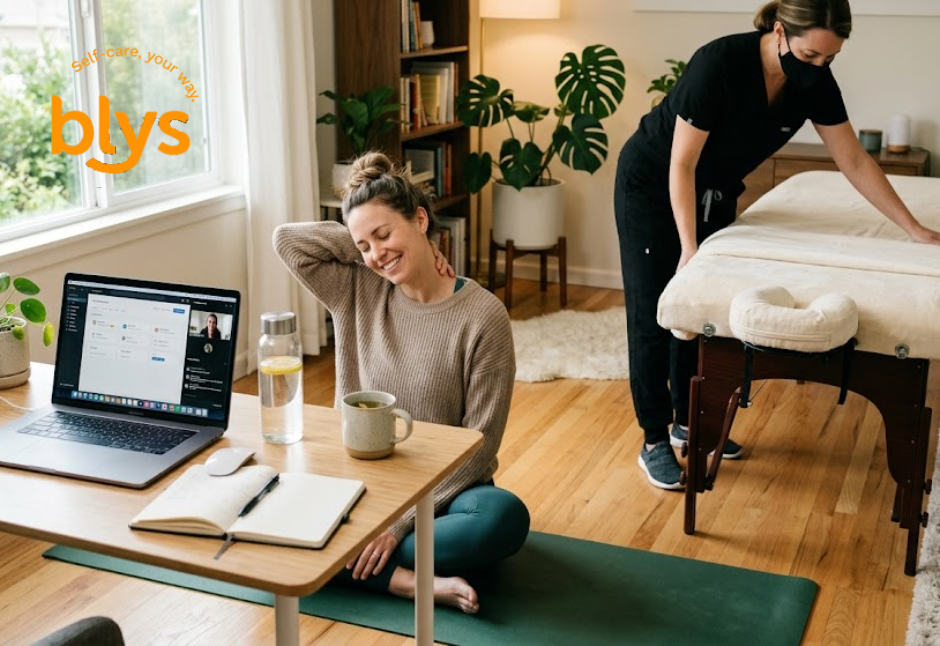
The Blys model is built on a simple premise: wellness comes to the employee, not the other way around. Through the platform, organisations can give staff access to vetted, insured, professional providers massage therapists, physiotherapists, sports recovery specialists — who come directly to an employee’s home or chosen location at a time that fits their schedule.
This single change in delivery removes the barriers that most consistently undermine uptake.
No Commute, No Clinic, No Friction
For a care worker finishing a twelve-hour rotation, a remote employee in a smaller city, or a shift-based retail worker with non-standard hours, travelling to a wellness appointment isn’t realistic not because they don’t value the benefit, but because the logistics don’t stack up.
When a trusted, professional provider comes to them instead, the calculation changes entirely. An at-home session can happen after a late shift ends, on a rest day, or on a weekend fitting around the employee’s real schedule rather than requiring them to reshape their day around a clinic opening.
Providers you book through Blys arrive with all necessary equipment, so there’s nothing to prepare on the employee’s end and no travel cost to absorb.
Flexibility That Works Around Rotas, Not Clinic Availability
Shift-based staff rarely have the luxury of a predictable, recurring free slot during the week. Rotas change, overtime happens, and the reliable weekday window that clinic appointment systems assume simply doesn’t exist for a lot of workers.
Blys operates across a wide range of hours evenings, weekends, and mornings after night shifts with on-demand booking through the platform. Staff schedule when their particular pattern opens up, rather than hunting for an overlap between their availability and a provider’s limited slots.
This is particularly relevant for healthcare organisations trying to support employee wellness across complex and changing rotas. Wellness programmes built for healthcare and shift-based workforces increasingly rely on at-home delivery precisely because it’s the only model that doesn’t demand a predictable schedule from the people using it.
Which Industries And Teams Benefit Most From At-Home Employee Wellness?
The at-home delivery model makes the greatest difference where the gap between “benefit on paper” and “benefit in practice” is widest. The table below maps the most significant use cases.
| Industry / Team | Why Conventional Benefits Fall Short | How At-Home Delivery Helps |
| Healthcare & Care Workers | Rotating shifts and nights conflict with clinic hours; manual handling creates high musculoskeletal load | Providers come after shifts end; no travel required; accessible around any rota |
| Remote & Distributed Teams | Geographic spread means clinic networks serve urban staff only | At-home delivery works anywhere in Canada; no location hierarchy |
| Logistics & Warehousing | Physical demands are high; no on-site wellness infrastructure; irregular hours | Platform access lets staff book vetted providers independently |
| Retail & Hospitality | Shift-based schedules; limited employer wellness infrastructure; often outside urban clinic networks | Benefit reaches staff at home, on their own time, without requiring employer facilities |
| Field-Based & Travelling Workers | Frequent relocations disconnect staff from home-city benefits | Blys works in any Canadian city; consistent access regardless of placement location |
Healthcare And Emergency Services Workers
Healthcare workers experience some of the highest rates of occupational musculoskeletal injury of any professional group in Canada. Patient handling, prolonged standing, repetitive clinical tasks, and irregular sleep create a cumulative physical load that conventional employee wellness programmes focused on office-based staff are not designed to address.
Research published on PubMed has consistently linked regular soft-tissue therapy and manual therapy with meaningful reductions in musculoskeletal pain, improved sleep quality, and lower self-reported stress in shift workers outcomes that translate directly into reduced sick days and better retention. For hospitals, long-term care facilities, and private healthcare employers, giving staff access to expert, trusted providers through Blys means the employee wellness benefit reaches the people who carry the greatest physical load, not just the administrative staff with standard hours.
Remote Teams And Geographically Dispersed Organisations
Canada’s geography makes the limitations of location-based wellness benefits particularly stark. For national organisations with staff spread across time zones and communities of every size — from Vancouver Island to Labrador a benefits package tied to a physical location creates a de facto two-tier system. Staff in major urban centres have real access; everyone else gets nominal coverage that doesn’t translate to actual sessions.
At-home delivery through Blys eliminates that disparity. The benefit is consistent regardless of where in Canada an employee is located, and it scales across the full geographic spread of a national workforce without any additional complexity for HR.
That consistency matters beyond logistics. Wellness and appreciation ideas that resonate with distributed teams share a common characteristic: they don’t require everyone to be in the same city. Employees who feel their working situation has been genuinely considered in how their benefits are structured report higher engagement and lower intent to leave.
How Do You Set Up At-Home Wellness As A Staff Benefit?
Getting at-home wellness up and running through Blys is designed to be straightforward for HR and people teams. Most organisations use one of the following structures, depending on team size, budget model, and how much autonomy they want to extend to staff:
- Wellness credits or vouchers: Employers purchase Blys credits that employees redeem through the platform for any available service massage therapy, physiotherapy, sports recovery, or other offerings. Staff choose what they book and when. Spend is predictable per head, and there’s no minimum group size or location requirement.
- Flexible benefits integration: For organisations already operating a flexible perks model, Blys can sit within a monthly or quarterly wellness allowance as an eligible spend category alongside gym credits, mental health support, and other discretionary health spending.
- Group and team wellness sessions: When distributed teams come together for a quarterly gathering, team offsite, or in-person collaboration day Blys can coordinate group sessions with vetted, insured providers attending a shared location. This gives teams a collective wellness moment during in-person time without requiring everyone to travel to a separate facility.
- Recognition and milestone credits: Some organisations use Blys credits as part of a broader recognition approach, giving employees a session credit as an acknowledgment of strong performance, a demanding period, or a significant milestone. Unlike physical gifts, a wellness session is genuinely useful regardless of where the employee is located.
Getting started involves a conversation with the Blys corporate team, who help organisations identify the right structure, manage provider logistics, and build the communication that drives staff awareness and uptake. The platform handles provider matching, scheduling, and payment centrally.
To explore the full range of options for Canadian organisations from individual employee vouchers through to ongoing team programmes the Blys corporate wellness page is the right place to start.
Make Your Employee Wellness Benefit Work For Everyone, Everywhere
A wellness programme only delivers value if your people can actually use it. For a significant portion of the Canadian workforce working shifts, working remotely, working in communities far from urban wellness infrastructure most conventional employee wellness benefits fall well short of that bar.
At-home delivery isn’t a bolt-on. It’s a change in the fundamental logic of how a benefit reaches an employee. When vetted, professional providers come to your staff wherever they are in Canada, whenever their schedule allows the access barriers that make so many wellness programmes underperform simply stop applying.
If your employee wellness benefit isn’t reaching your shift-based staff, your remote team, or your employees outside major urban centres, the delivery model is most likely the bottleneck. The right service, delivered the right way, reaches everyone.