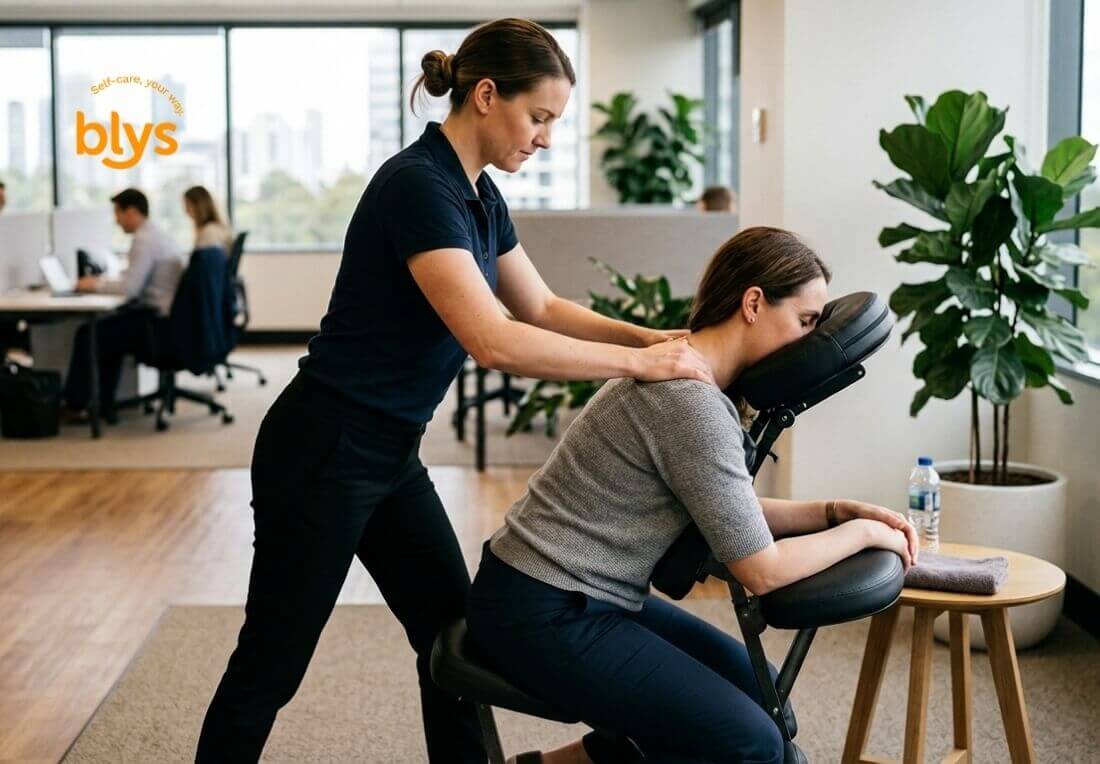
Whether corporate massage is tax deductible in Canada, and whether it creates a taxable benefit for employees, depends on how the program is structured and which CRA rules apply. The Canada Revenue Agency treats most employer-provided benefits as taxable income to the employee, but there are specific exemptions that remove the liability for many corporate massage programs.
Here’s the honest breakdown on the “is corporate massage tax deductible in Canada” question, including CRA rules and what they mean for your program.
Corporate Massage CRA Treatment: Employment Benefit Rules
When a Canadian employer pays for employee massage benefit Canada rules apply, the CRA generally treats it as a taxable employment benefit. This means the value of the benefit must be included in the employee’s income and reported on their T4 slip, and both the employee and employer pay the relevant payroll deductions on it.
Two CRA frameworks are worth understanding, though neither offers a clean exemption for most corporate massage programs: the gifts and awards policy, and the CRA’s position on health-related benefits.
The CRA Gifts and Awards Policy: The Most Useful Pathway
The CRA gifts and awards policy is narrower than it might appear, and it’s worth understanding the limitation before assuming it applies to a corporate wellness program.
Under the current CRA policy, a non-cash gift or award is only exempt from income (up to $500 per employee per year) in two specific circumstances: it’s a gift given for a special personal occasion such as a birthday, wedding, religious holiday, or birth of a child, or it’s a formal award recognising an employee’s overall contribution through a program with defined criteria, a nomination process, and a limited number of recipients.
A generic wellness day where all staff receive a massage doesn’t clearly fit either category. It’s not tied to a personal milestone, and it’s not a formal recognition award. This is a materially different fact pattern from Australia’s minor benefits exemption or the UK’s trivial benefits rule, both of which are general-purpose small-value tests with no occasion or recognition requirement.
The honest position is that a corporate massage Canada wellness day massage sits in real interpretive uncertainty under Canadian tax law, and this is the market version of this series where “confirm with your accountant” carries more weight than anywhere else. The likely treatment is that the benefit is taxable, with the value reported on the T4 and payroll deductions applying accordingly.
The $500 Cap Is Annual, Not Per Occasion
Unlike the UK’s £50 per-occasion trivial benefits rule or the AU’s $300 per-occasion minor benefits rule, the CRA’s $500 threshold applies across the full calendar year. A business providing massage multiple times a year needs to track the cumulative value per employee, once the $500 threshold is crossed, the excess becomes a taxable benefit that needs to be included on the T4.
When This Exemption Doesn’t Apply
If the total value of non-cash gifts and awards provided to an employee exceeds $500 in a year, the amount over $500 is a taxable benefit. A regular recurring massage program, weekly or fortnightly, is likely to exceed this threshold quickly, which means most of the benefit will be taxable.
Employee Wellness and Health Benefits
The CRA also has a position on employer-provided health and wellness benefits that’s worth understanding alongside the gifts and awards policy.
Employer contributions to a Private Health Services Plan, which is the most tax-efficient massage employee benefit CRA structure (PHSP) are generally deductible for the employer and not taxable to the employee. However, PHSPs are structured insurance or coverage arrangements, not individual service payments. A direct payment to a massage therapist for employee sessions doesn’t qualify as a PHSP contribution, it’s a direct benefit, which brings it back into the gifts and awards framework.
Some employers structure wellness programs through a Health Spending Account (HSA) or Wellness Spending Account (WSA). HSAs can cover massage therapy if the employee has a prescription or medical referral (in provinces where massage is eligible as a medical expense), and employer contributions to HSAs within certain limits are not taxable. WSAs are funded by the employer but the withdrawals are generally treated as taxable income to the employee. The right structure depends on your existing benefits framework and what your plan provider allows.
What the Employer Can Deduct
Regardless of whether the benefit is taxable to the employee, the employer can generally deduct the cost of providing corporate massage as a business expense against its taxable income, provided the expense is reasonable and incurred for business purposes. Employee retention, wellbeing, and productivity are accepted business purposes under CRA guidance.
For corporate massage Canada programs structured as taxable employment benefits, the employer deducts the cost of the sessions. For programs that qualify under the gifts and awards exemption, the employer still deducts the cost; the exemption applies to the employee’s tax treatment, not the employer’s deduction.
Provincial Considerations
Canada’s provinces have their own payroll tax rules that interact with the federal CRA framework. Quebec, for example, has its own payroll tax and benefit rules administered by Revenu Québec rather than the CRA, and the treatment of employee benefits can differ from the federal framework. Ontario’s Employer Health Tax (EHT) applies to total remuneration including taxable benefits, which affects the employer’s total cost.
If your business operates across multiple provinces, confirming the provincial treatment alongside the federal CRA analysis is worth doing before finalising your program structure.
What This Means for Your Program
One-Off Wellness Day
A one-off corporate wellness day massage is likely a taxable employment benefit under CRA rules. The gifts and awards exemption doesn’t apply cleanly to a generic wellness perk, the CRA’s policy was designed for personal milestone gifts and formal recognition awards, not blanket staff perks. The value should be reported on the T4, and payroll deductions apply. The employer deducts the cost as a business expense.
Regular Program That Exceeds $500 Per Employee Annually
If the total value of massage benefits provided to any employee exceeds $500 in a calendar year, the excess is a taxable employment benefit that must be reported on the T4. The employer pays the cost and deducts it as a business expense. The employee pays income tax on the taxable portion. Worth structuring with your accountant or payroll provider before launch.
Health Spending Account Route
If your business already has an HSA or is considering one, massage therapy may be covered as an eligible expense in provinces where it qualifies as a medical expense, provided the employee has a prescription or referral. The tax treatment of HSA contributions and withdrawals depends on the plan structure, confirm with your plan provider and accountant before assuming coverage.
Always Check With Your Accountant
The framework here reflects CRA rules and guidance as at mid-2026, but tax rules change and provincial treatment varies. The CRA’s gifts and awards policy has been updated periodically, and individual circumstances, business structure, province of operation, existing benefits arrangements, all affect the outcome.
A tax accountant or payroll specialist familiar with your business is the right person to confirm the treatment before you structure your program around it.
Blys provides per-session invoicing broken down by employee if you need it for T4 reporting. For setup and costs, the corporate massage workplace wellness guide for Canada covers types, session lengths, and how to run the program. It’s worth reading before committing to a program frequency that affects the CRA treatment.
Book corporate massage for your Canadian team through Blys, a qualified therapist comes to your office with everything needed.