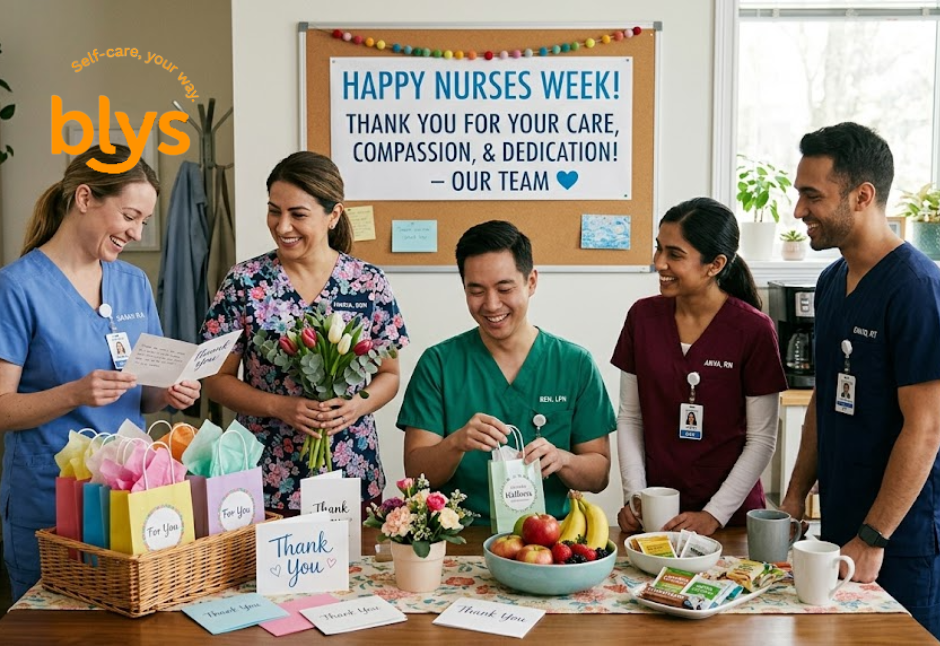
 If you manage nurses or other healthcare professionals across Canada’s public or private health system, national nursing week observed every year in the second week of May probably brings with it a familiar mix of intention and pressure. You want to do something meaningful. Something that reaches the people on your team who are running on short sleep, long shifts, and an extraordinary amount of goodwill that deserves to be genuinely returned.
The teams with the strongest retention aren’t always those who ran the best national nursing week activities. They’re the ones whose managers built conditions that made the work sustainable consistently, well past May. Recognition matters enormously. What it connects to matters more.
This guide is for managers and team leads who want to use national nursing week as a real starting point, not a symbolic one. You’ll find practical recognition ideas, an honest look at why wellbeing in healthcare has to be structural, and a closer look at how at-home wellness services work as a staff benefit your team can access on their own time not yours.
What National Nursing Week Gives You as a Manager and How Not to Waste It
National Nursing Week in Canada runs the second week of May each year, anchored by International Nurses Day on 12 May Florence Nightingale’s birthday. Championed by the Canadian Nurses Association and recognised across provincial health systems, long-term care, and community health settings, it’s a moment for advocacy to surface workforce realities. For managers, it’s a high-visibility window to reset what staff wellbeing looks like on your team.
The risk is treating national nursing week as a pressure valve a concentrated burst of appreciation that substitutes for structural support the other 51 weeks. Nurses across Canada’s health system are clear-eyed about their environment. If recognition feels like theatre, it will be received exactly that way.
Research via PubMed on nurse recognition and turnover intent consistently links perceived organisational support to lower turnover a finding with real operational weight in a sector facing ongoing workforce pressures. The case for genuine recognition isn’t separate from the business case. They’re the same case.
Use national nursing week as a visible, public commitment then make sure what you commit to is still running in November.
Why Recognition Without Structural Support Won’t Prevent Burnout
Recognition is necessary. It’s not sufficient. A nurse who feels genuinely appreciated but still works understaffed rosters, skips meals on shift, and drives home exhausted after a 12-hour night will not stay engaged for long regardless of how well-organised the national nursing week activities were.
Wellbeing in healthcare is structural as much as it’s interpersonal, and conflating the two leaves managers confused about why their teams are burning out despite all the appreciation. That said, what managers can directly influence culture, feedback quality, access to real support matters significantly. Here’s where to focus.
Is your recognition specific and timely?
Generic praise ‘you’re all doing a great job’ registers as background noise. Specific, timely acknowledgement ‘the way you managed that transition of care on Tuesday showed real skill’ signals that you’re paying attention to individuals, not just shift reports. It also builds the kind of feedback culture where people feel safe raising concerns, not only receiving compliments.
Gallup’s State of the Global Workplace research finds consistently that employees who feel their contributions are recognised report meaningfully lower burnout even in high-pressure environments. The mechanism isn’t the compliment. It’s the feeling of being seen as a person, not a resource on a roster.
Are you creating space for honest conversations?
Appreciation doesn’t flow only through what you say. It flows through whether your team believes they can tell you when something isn’t working. Regular one-on-ones that go beyond scheduling logistics, and genuine psychological safety in team settings, are the foundation any wellbeing programme has to rest on.
If national nursing week is the only time leadership asks ‘how are you doing?’ that’s the gap worth closing first.
National Nursing Week Ideas That Go Beyond the Gesture and Stick Year-Round
If you’re planning something for your team this May, here are approaches that connect recognition to what nurses actually need including the physical recovery that at-home wellness makes easy to access around even the most demanding shift patterns.
Structured recovery time
After high-acuity periods, end-of-life care stretches, or significant incidents, build in protected debrief time or lighter-load days. This signals that emotional labour is acknowledged alongside clinical workload and that recovery matters operationally, not just personally.
Access to professional physical recovery support
Healthcare work is physically demanding in ways that accumulate quietly over a career. Giving staff access to professional massage or recovery services especially services that come directly to them at home rather than requiring more travel after a long shift removes the barrier that stops most people using a benefit they technically have.
For nurses working evenings, nights, or compressed schedules, a vetted provider who arrives at their door removes the one obstacle standing between them and actually recovering.
Recognition shaped around individual preferences
Some nurses want public acknowledgement; others find it uncomfortable. Some want time off; others want professional development. A short anonymous survey during national nursing week surfaces preferences you didn’t know and shows that the recognition itself is thoughtful, not one-size-fits-all.
Wellbeing budgets rather than wellbeing events
A small individual wellness allowance spent on whatever each person actually needs signals trust in a way that organised team experiences don’t always manage. What recovery looks like differs dramatically from one nurse to the next.
For a broader look at building sustainable wellbeing programmes in healthcare, the workplace wellness guide for healthcare workers covers the structural factors that matter most.
Why At-Home Wellness Services Are a Better Fit for Canadian Nursing Teams Than Clinic-Based Options
Here’s something most national nursing week content never addresses: the logistics problem. Healthcare workers often finish shifts at unconventional hours, far from wellness studios, with bodies that have been on their feet for 10 to 12 hours. Expecting a nurse who has just finished a night shift to drive across town, find parking, and sit in a waiting room is a genuine barrier even if the appointment is fully covered.
At-home wellness services solve this directly. Instead of your team travelling to the appointment, the appointment comes to them. Massage therapists and other wellness providers booked through Blys can arrive at a staff member’s home at a time that fits their roster 7am before a rest day, Sunday afternoon between shift blocks, or a weekday evening.
The providers you book through Blys are vetted, insured, and professional, which matters when you’re offering something to staff as a formal benefit.
This model works for nursing teams for several clear, practical reasons:
- Recovery happens at home: After a demanding shift, most nurses don’t want more travel or waiting rooms. A vetted provider arriving at the door means staff are significantly more likely to actually use the benefit which is the entire point.
- It scales across locations: If your team is spread across multiple sites, wings, or community health settings, an at-home model scales without logistical overhead. No venue to arrange. No transport to coordinate.
- It’s substantive, not symbolic: Professional physical recovery support communicates something different to your team than a gift card. It says you understand what healthcare work does to a body over time and you’ve done something meaningful about it.
For organisations exploring this as part of an ongoing programme, Blys Corporate Wellness offers group accounts and team booking options built for exactly this use case. You can also check local providers near your team to see what’s available in your area.
What Happens After National Nursing Week Is the Real Test of Your Commitment
Your team will feel the difference between recognition attached to structural support and recognition designed to make leadership feel good for a week. A staff breakfast in May and a forgotten initiative by July is a pattern most healthcare managers will recognise. Break that pattern this year.
Pick two or three commitments you can sustain: a wellness allowance, a monthly check-in that goes somewhere real, access to at-home recovery services through a trusted platform. Set a six-month review and look at what moved staff satisfaction trends, sick leave rates, turnover figures. The results will tell you what to keep and where to adjust.
The nurse burnout and shift work wellness guide covers the cumulative physical and psychological impact of shift patterns in more depth worth reading alongside anything you’re building for the longer term.
If you’re looking for a concrete starting point right now, the providers you book through Blys are vetted, insured, and available across Canada giving your nurses something they’ll actually use, on the schedule that works for them. Recognition matters. Build something around it.