Most gym-goers train hard, but recovery often gets pushed aside. Rest days are seen as time off, even though they are when the body actually adapts. Muscle repair, strength gains, and performance improvements all depend on how well the body recovers between sessions.
Active recovery is not about being inactive. It supports the body’s natural repair processes so muscles can reset and perform again. When recovery is overlooked, soreness lingers, movement feels restricted, and training quality suffers.
Professional recovery is not a luxury. Techniques like lymphatic drainage massage and myofascial release help the body recover more efficiently, making rest days a strategic part of training rather than lost time.
What Active Recovery Really Means
Active recovery is often reduced to stretching or foam rolling. These can help, but they only work at a surface level. Passive rest means doing very little and hoping soreness fades. Self-led recovery adds light movement or mobility work, which supports circulation but has limits once fatigue builds up.
Professionally guided recovery targets deeper systems involved in repair and movement quality, which are harder to influence alone, especially with frequent training.
Muscle soreness is not a reliable sign of progress. Research on delayed onset muscle soreness shows that ongoing soreness often reflects incomplete recovery and can affect strength, endurance, and injury risk if left unaddressed.
The Lymphatic System and Exercise Recovery Explained Simply
Strenuous training creates fluid shifts and waste that the body needs to clear for recovery to happen. When this process slows, soreness and heaviness tend to hang around.
The lymphatic system plays a central role in clearing that post-exercise load, which is why it matters so much for active recovery.
What the lymphatic system does after workouts
During and after exercise, the body produces metabolic waste, inflammatory by-products, and excess fluid in worked muscles. The lymphatic system helps collect and transport these substances away from tissues so repair can begin. When this clearance runs efficiently, muscles settle faster, inflammation reduces, and recovery feels more complete rather than dragged out over several days.
Why movement and stimulation matter
Unlike the circulatory system, the lymphatic system has no pump to keep fluid moving. It relies on muscle contraction, breathing patterns, and gentle external stimulation to function properly. After intense sessions, many gym-goers move less, sit more, or tighten up protectively.
Such actions can slow lymph flow, particularly in areas that were heavily loaded, such as the legs, hips, or lower back.
How poor lymphatic flow affects recovery
When lymph flow is sluggish, excess fluid and waste remain trapped in the tissues. This often shows up as lingering soreness, stiffness, swelling, or a heavy feeling that stretching alone does not resolve.
Over time, incomplete clearance can make rest days feel less effective and leave muscles feeling under-recovered heading into the next session. Supporting lymphatic movement helps shorten this recovery window and prepares the body to train again with better quality.
How Lymphatic Drainage Massage Supports Muscle Recovery
Lymphatic drainage massage supports recovery by helping the body clear post-exercise waste and excess fluid without adding stress to tired muscles.
The technique uses slow, rhythmic movements with very light pressure. Because lymph vessels sit close to the surface, gentle stimulation encourages fluid movement, while heavy pressure can restrict flow.
How lymphatic drainage massage supports muscle recovery:
- Uses gentle, rhythmic movements to stimulate lymph flow.
- Helps clear exercise-induced fluid buildup and metabolic waste.
- Reduces heaviness, swelling, and lingering soreness.
- Supports recovery after heavy leg days, HIIT, and endurance sessions.
- Works well between back-to-back training days.
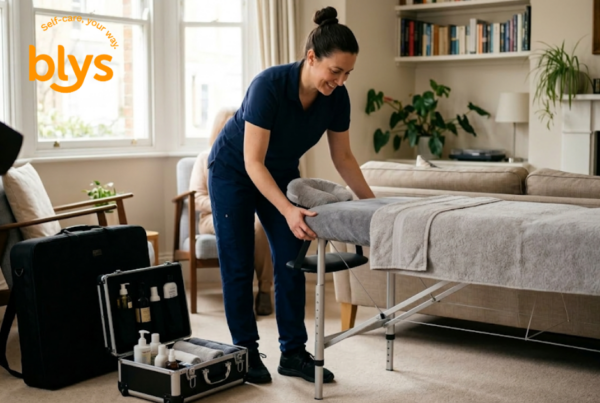
This approach underpins Blys’ at-home lymphatic drainage massage service, making recovery easier to maintain without travelling.
If recovery time is limited, booking an at-home lymphatic drainage massage with Blys can help rest days work harder for your training.
Why Tight Muscles Aren’t Always the Problem
When muscles feel tight after training, the issue is not always the muscle itself. Often, the restriction comes from the connective tissue that supports movement.
Key points to understand:
- Fascia is a connective tissue system that links muscles, joints, and movement patterns.
- It helps transmit force and allows muscles to glide smoothly during exercise.
- Repetitive training and heavy loading can reduce fascial elasticity.
- Adhesions and trigger points can form within fascia over time.
- Stretching targets muscle length but may not address fascial restriction.
When fascia becomes restricted, muscles can feel tight as a protective response. This is why stretching alone sometimes fails to restore comfortable movement or lasting relief after workouts.
What Myofascial Release Therapy Does That Stretching Can’t
Stretching improves muscle length, but it does not always address deeper restrictions. Myofascial release therapy targets the fascial system, where many movement limitations develop.
It uses slow, sustained pressure rather than quick movements, allowing restricted tissue to soften and restore normal muscle glide. Repetitive training and heavy loading can create fascial adhesions that limit range of motion and affect how force is distributed.
Myofascial release therapy helps release these restrictions, supporting more efficient movement.
How myofascial release therapy differs from stretching:
|
Approach |
How it works | What it affects | Impact on performance |
| Stretching | Short, repeated movements | Muscle length |
Temporary relief |
|
Myofascial release therapy |
Slow, sustained pressure | Fascial adhesions | Improved mobility and load distribution |
| Stretching | Surface-level input | Muscles only |
Tightness often returns |
|
Myofascial release therapy |
Deep tissue adaptation | Muscles and fascia |
More lasting movement changes |
This approach underpins Blys myofascial release therapy service, delivered at home to support recovery and performance without disrupting training.
Performance Benefits Gym-Goers Actually Notice
When recovery is properly supported, the results are practical and easy to feel in training. Rather than abstract wellness claims, gym-goers tend to notice clear changes in how their body performs between sessions.
Performance benefits commonly include:
- Faster return to training after intense or high-volume workouts.
- Reduced post-session soreness, allowing muscles to recover more smoothly.
- Improved mobility under load during lifts and dynamic movements.
- This leads to improved form because there are fewer compensation patterns from tight or restricted tissue.
- Fewer recurring niggles that often appear when recovery is incomplete.
By supporting muscle recovery naturally, the body adapts more efficiently instead of repeatedly working through fatigue. Over time, training feels more consistent, movement feels more controlled, and progress becomes easier to maintain without frequent setbacks.
Have you noticed lymphatic drainage massage is often used for bloating and fluid retention? Our guide shows how the same lymphatic support helps post-workout recovery.
When to Book Recovery Work Around Your Training
Recovery works best when it fits your real training routine. Timing and consistency matter more than how intense a single recovery session feels.
Some gym-goers benefit most from recovery the day after heavy sessions, especially lower-body or full-body workouts. Others prefer booking on rest days once the body has settled. Both approaches work when recovery supports the next session rather than replacing training.
A simple way to plan recovery around training:
|
Training pattern |
Best time to book recovery | Suggested frequency | Why it works |
| Heavy strength sessions | Day after training | Weekly |
Helps settle soreness before stiffness builds. |
|
Structured rest days |
On rest days | Weekly or fortnightly | Supports repair without interfering with workouts. |
| Regular training (3–5x/week) | Fixed weekly slot | Weekly |
Maintains consistency and movement quality. |
|
Peak or high-volume blocks |
Between hard sessions | Weekly or increased as needed | Reduces overload and recurring niggles. |
| Lighter or maintenance phases | Flexible | Fortnightly |
Supports recovery without over-servicing. |
The key is consistency. Regular, well-timed recovery supports muscle repair and training quality far more effectively than occasional, reactive sessions booked only when soreness peaks.
Have you noticed lymphatic drainage massage is often used for bloating and fluid retention? See our guide to see how lymphatic drainage supports fluid relief and recovery.
Why At-Home Recovery Works Better for Active People
Recovery often gets skipped because it feels inconvenient. At-home recovery removes that barrier, making it easier to recover without adding stress to an already full schedule.
Why at-home recovery works so well:
- Avoids travel after hard sessions: Travelling post-workout can increase fatigue and stiffness. At-home treatment lets recovery start immediately.
- Reduces stress on fatigued systems: Removing commuting and waiting helps the body shift into recovery more easily.
- Improves consistency through convenience: When recovery fits into daily routines, it is easier to maintain regularly.
- Fits real training schedules: Early-morning and evening gym-goers are not limited by clinic hours.
- Supports deeper relaxation: Recovering at home allows the body to settle more fully, improving recovery quality.
This is where Blys supports active people by making recovery practical rather than disruptive.
Book a targeted at-home recovery massage with Blys to support performance without interrupting your training routine.
Who Benefits Most From Professional Active Recovery
Professional active recovery is most helpful for people who train regularly and place repeated demands on their body.
Those who tend to benefit most include:
- Strength trainers and CrossFit-style athletes: Heavy lifts and high training loads create cumulative fatigue that benefits from targeted recovery.
- Runners and endurance athletes: Repetitive impact and high mileage increase the need for consistent recovery support.
- Desk workers who train hard outside work: Long periods of sitting combined with intense training can limit circulation and mobility.
- Anyone training three or more times per week: Frequent sessions leave less time for natural recovery alone.
Research shows that structured recovery strategies can help manage soreness and reduce injury risk as training load increases.
Wrapping Up
Rest days are not lost training time. They are where adaptation happens. When recovery is treated as a strategic part of training, performance becomes easier to sustain rather than something to push through.
Lymphatic drainage massage supports recovery by helping the body clear post-exercise fluid and metabolic waste, reducing lingering soreness and heaviness. Myofascial release therapy works at a deeper level, addressing connective tissue restrictions that affect movement quality, load distribution, and long-term resilience. Together, they support recovery at a physiological level rather than masking fatigue.
For gym-goers who train consistently, recovery is not optional. It is part of the programme. With at-home treatments delivered through Blys, professional recovery becomes accessible, flexible, and realistic, helping you train better, longer, and more consistently without disrupting your routine.