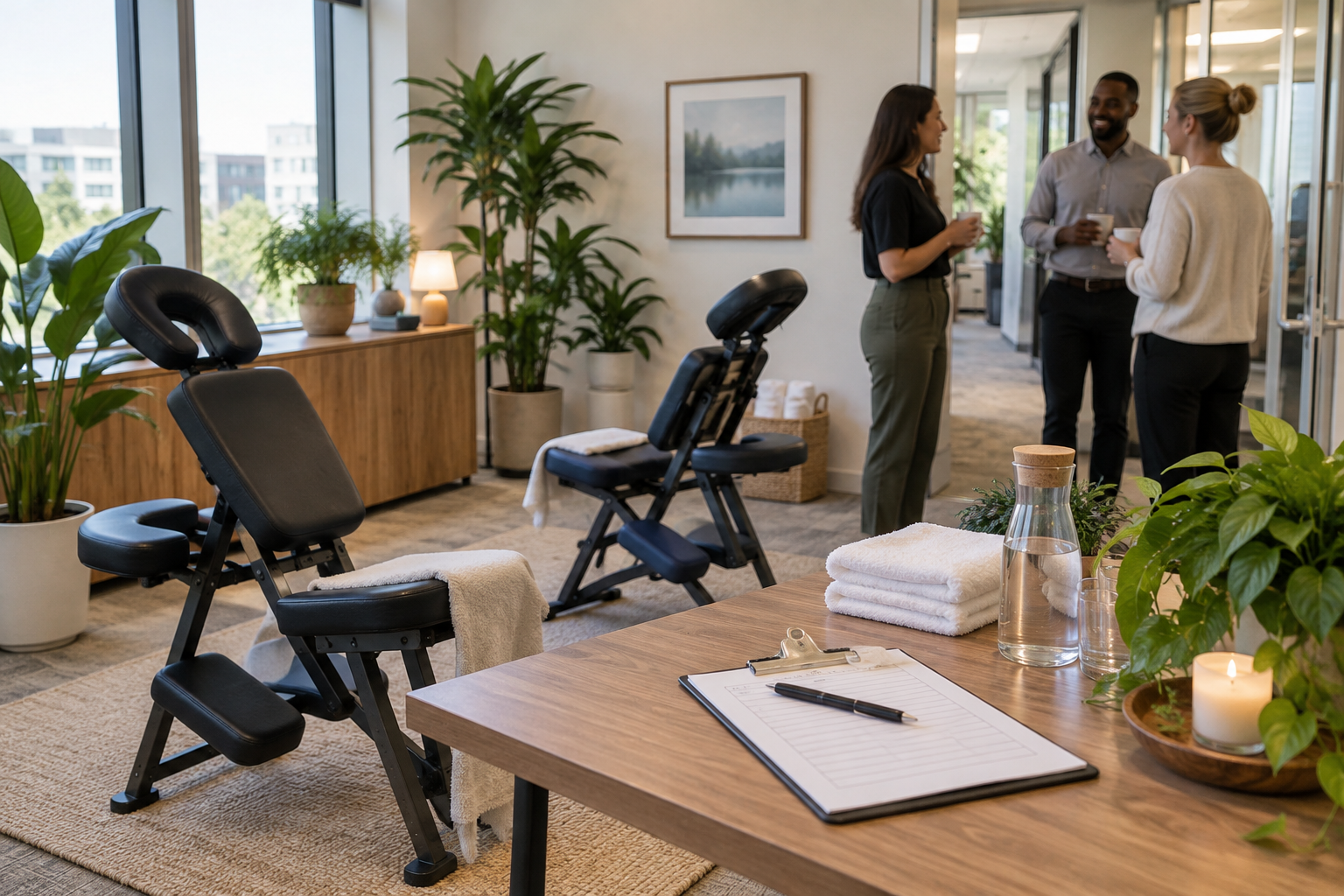
Plan for about 70% of employees to take part, book 15-minute chair sessions, and count on each therapist seeing 3 to 5 people an hour. A 50-person office works out to about 9 chair-hours. Clear 3ft x 5ft per chair, book at least 48 hours ahead, and collect license and insurance paperwork before the day.
At a glance
| Step | What to settle |
|---|---|
| Choose the format and session length | Chair, table or desk massage, and minutes per person |
| Estimate how many people will take part | About 70% of headcount |
| Turn attendees into therapist-hours | Attendees times session length |
| Find and prepare the space | Floor space, privacy and parking |
| Book with enough notice | At least 48 hours, more for big groups |
| Collect the license and insurance paperwork | State license and certificate of insurance |
| Set the budget, including tips | Therapist-hours, fees and an optional tip |
| Open sign-ups | Fixed slots employees book themselves |
| Run the pre-event checklist | The week before, the day before, on the day |
1. Choose the format and session length
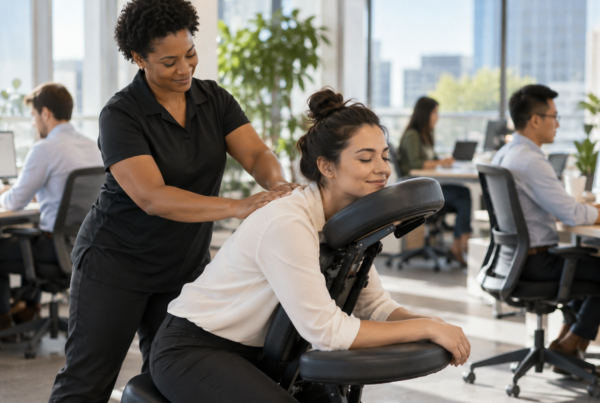
Short chair sessions are the most popular option for workplace wellness days, according to Blys. Employees stay fully clothed, no oil is used, and they walk straight back to their desks. Table massage suits longer sessions if you have a private room. Desk massage needs no floor space, because the therapist comes to each desk.
| Format | Session length | Space | Clothing |
|---|---|---|---|
| Roving or desk massage | From 5 minutes | None, done at the desk | Fully clothed, no oil |
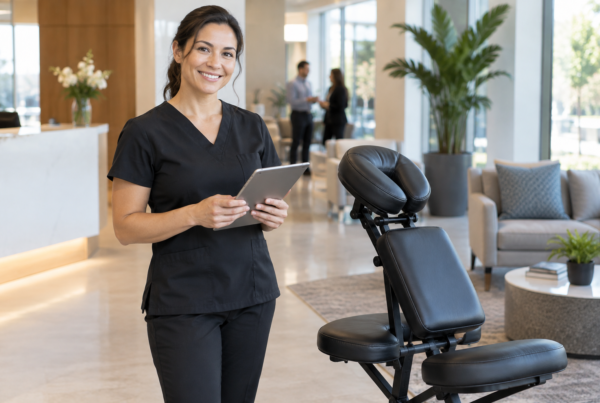
| Chair massage | Usually 10 to 30 minutes | 3ft x 5ft per chair | Fully clothed, no oil |
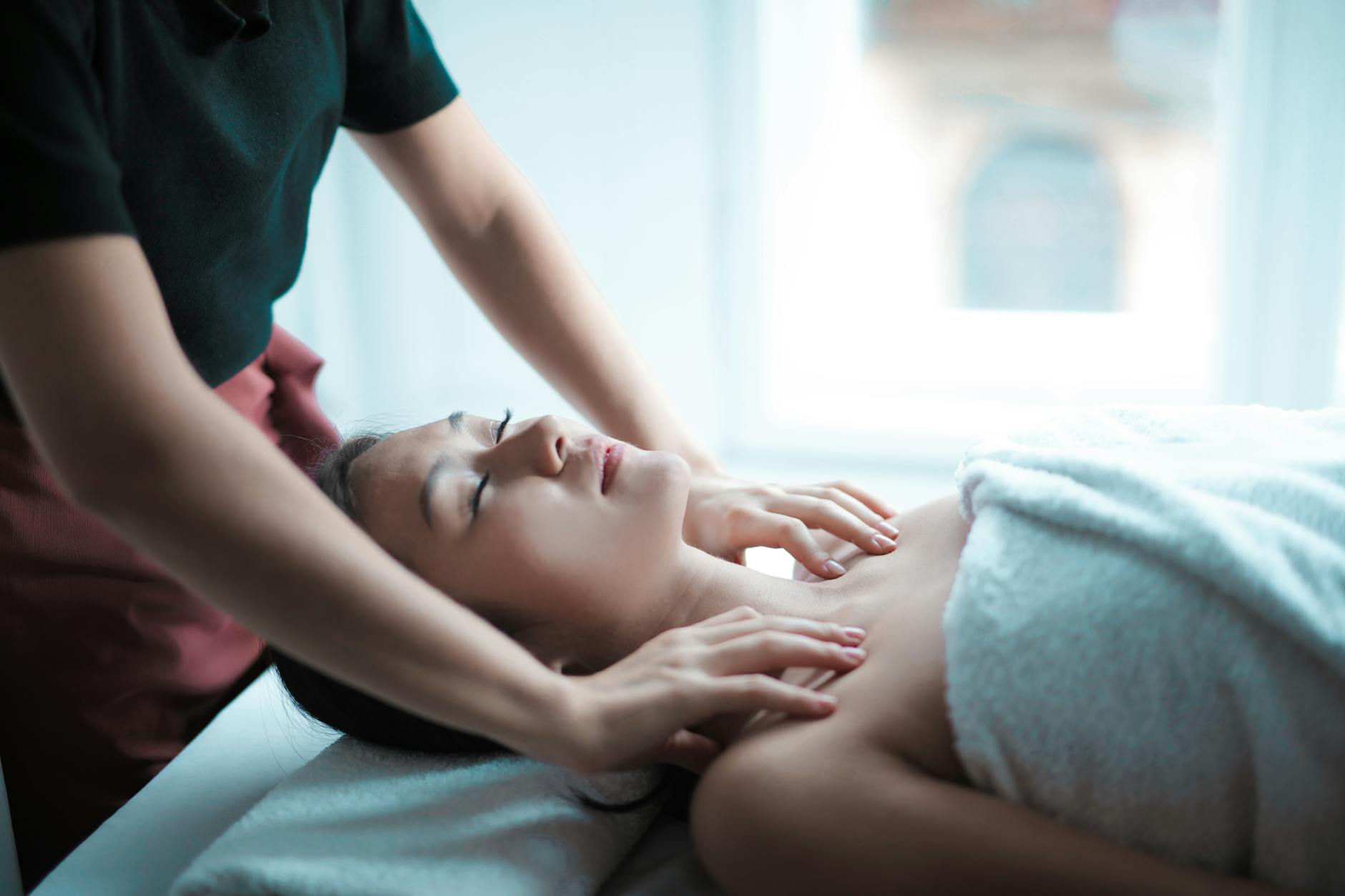
| Table massage | 30 minutes minimum | 6.5ft x 6.5ft private room or area per table | Draping provided, oils used |
These are the minimums and space figures Blys publishes for US corporate bookings. For a wellness day, 15 to 20 minutes is the most popular chair session, long enough to give real relief and short enough to fit between meetings.
2. Estimate how many people will take part
Not everyone signs up, so start from expected take-up rather than headcount. Blys’s general rule is that take-up of massage is around 70%, so an office of about 50 people should expect around 35 attendees.
A quick poll a couple of weeks out shows whether your team runs above or below it. Count hybrid employees only if they will be in that day.
3. Turn attendees into therapist-hours
Multiply attendees by session length to get chair-hours. Thirty-five people at 15 minutes each is 8.75 hours, or about 9 chair-hours. At 15 minutes each, one therapist sees at most 4 people an hour.
Then split the hours across therapists. On Blys the minimum is 2 hours per therapist (1 hour for schools and education), and a session over 4 hours includes a 30-minute paid break automatically.
| Office size | Expected attendees at 70% | Chair-hours at 15 minutes each | One way to cover it |
|---|---|---|---|
| 20 people | 14 | 3.5 | 2 therapists for 2 hours |
| 50 people | 35 | 8.75 (about 9) | 3 therapists for 3 hours |
| 100 people | 70 | 17.5 | 6 therapists for 3 hours |
| 200 people | 140 | 35 | 9 therapists for 4 hours |
Worked from the 70% rule and 15-minute sessions. Fewer therapists for longer suits an all-day drop-in.
4. Find and prepare the space
A massage chair needs a clear area of about 3ft x 5ft: a corner of a break room, a meeting room or an event floor works. A table needs about 6.5ft x 6.5ft in a private room or area. Leave room at each station for the next person to wait.
A separate room is not essential for chair massage, but it helps people relax. Book the room for the event plus 15 minutes of setup and 15 minutes of pack-down per therapist.
Therapists booked through Blys bring the chairs or tables, disposables and music, and wipe chairs down with antibacterial between clients under a fresh paper cover. You supply the room, a way in and somewhere to park. Some corporate clients on Blys provide visitor parking. On Blys, a venue with no free or metered parking adds a per-provider surcharge, confirmed in your quote.
5. Book with enough notice
Lock in the date once you have a headcount estimate. A larger group needs more therapists free at once, so it needs more lead time.
On Blys you can book instantly online through Blys for Teams, or request a quote, which arrives within 24 hours. Blys needs 48 hours’ notice to secure a booking, and requests inside 48 hours are harder to fill, so give groups at least 48 hours. Corporate bookings are paid in advance by card or invoice, and you are only charged once the booking is confirmed.
Check cancellation terms before you confirm. On Blys, for groups of 4 or more, cancelling 72 or more hours out costs the 10% platform fee only, 48 to 72 hours out costs 20% of the booking value, 24 to 48 hours out 50%, and under 24 hours 100%.
6. Collect the license and insurance paperwork
The Federation of State Massage Therapy Boards lists licensure as required in 49 states and territories, registration in Vermont, voluntary certification in California, and no state regulation in Kansas, Minnesota and Wyoming. Ask for each therapist’s state license number and check it on your state board’s website.
Then ask your building or venue manager what they need from outside vendors. If they want a certificate of insurance (COI), find out whose name it should carry and how far ahead they need it.
Massage therapists on Blys hold a valid license in their state wherever the state issues one, which Blys checks and verifies, and they are insured and background checked. Blys can also provide a certificate of insurance to a corporate client or venue on request.
7. Set the budget, including tips
Build the budget from the therapist-hours in step 3. On Blys, chair massage is $119 per provider-hour on weekdays during standard business hours, with a 2-hour minimum, and a 10% service fee is added to confirmed bookings. For the 9 chair-hours in step 3, that is about $1,178 before any tip.
A per-provider surcharge applies to early morning (6am to 9am), evening (6pm to 9pm) and late-night (9pm to midnight) bookings, weekends and public holidays, hotel or conference venues, and venues with no free or metered parking. The amounts are confirmed in your quote.
Blys says a corporate booking can work out at as little as $20 per person. That figure is the total booking cost divided by the number of attendees. At $119 an hour it means about 6 people an hour, or 10-minute sessions, before the 10% service fee.
Tipping is optional and not included in the corporate price. If you tip, add it separately before, during or after the booking, and tell employees up front whether the company covers it.
8. Open sign-ups
Fixed time slots beat a walk-up line: people plan around meetings and therapists stay busy. Open sign-ups about a week out, stagger slots by team so a whole department is not away at once, and keep a waitlist for no-shows.
On Blys, the booking creates a calendar link to share with employees. Each person books with their name and email, gets a confirmation email with a meeting invite, and can change or cancel their slot. When slots fill, people join a waitlist and are notified first come, first served. Organizers can download a PDF schedule.
9. Run the pre-event checklist
The week before:
- Confirm the number of therapists and the start and finish times.
- Send the certificate of insurance and therapist details to building security or reception.
- Book visitor parking, or tell the therapists where to park and how to get in.
The day before:
- Check the room booking covers setup and pack-down, and ask whether therapists need a power outlet.
- Print the schedule and post it outside the room.
On the day:
- Meet the therapists at the entrance and walk them to the room.
- Keep one person on hand to send people in and fill no-show slots.
- Ask for feedback the same afternoon.
Frequently Asked Questions
How many people can one massage therapist see in an hour?
On average, one therapist sees 3 to 5 people an hour, depending on how long each session is. For a group, multiply attendees by session length to get chair-hours, then divide by the hours the event runs to get the number of therapists.
Do employees need to get changed for an office massage?
Not for chair or desk massage. Both are done fully clothed and, on Blys, without oil, so people go straight back to work. Table massage is different. It uses oils, the therapist brings draping for privacy, and it needs a private room or area.
Is an office massage day a taxable benefit for employees?
It depends on how often you offer it. The IRS treats a benefit as de minimis, and so excludable from wages, when its value and frequency make accounting for it unreasonable or impractical, and it says an essential element is that the benefit is “occasional or unusual in frequency.” A one-off wellness day is more likely to fit than a weekly program. Check your plan with your tax adviser. Blys provides per-booking tax invoices and monthly consolidated invoicing.
What happens if a therapist drops out after the booking is confirmed?
On Blys, the booked time slots stay the same. The scheduling link you shared with your team keeps working, so employees can still see and book their slots while a new provider is confirmed for that time. Nobody has to rebook and you do not need to resend the link.
Plan your office massage day with Blys
Blys for Business works nationwide, in all major US cities. Book instantly online through Blys for Teams and pay by card or invoice, or tell Blys your team size, the services you want and your budget, and an Account Coordinator comes back with a quote within 24 hours. US corporate clients include Dell, Samsung, California Ambulance Association, SEGA, CARE, Amazon and Cartier North America.
More on workplace massage: corporate massage, chair massage, corporate wellness, event massage and pricing.