 Employee wellness programs have shifted from optional perk to competitive necessity and the cost of getting them wrong is measurable. The American Institute of Stress estimates workplace stress alone costs US employers over $300 billion annually in absenteeism, lost productivity, and healthcare expenses.
But most programs share a structural flaw that rarely gets named: they’re built around a fixed location. They assume your employees are office-based, near a clinic, and available during predictable hours. For remote workers, night-shift healthcare staff, warehouse teams, and distributed employees spread across states, that assumption doesn’t hold.
This article looks at why the delivery model is the real problem, how at-home wellness solves it, and what it takes to build an employee wellness program that actually reaches everyone.
Is Your Employee Wellness Program Only Working For Half Your Team?
The default architecture of most corporate wellness programs was designed for a specific kind of employee: office-based, standard business hours, with a gym or clinic nearby and enough schedule flexibility to use it regularly. That archetype covers fewer and fewer American workers.
The Bureau of Labor Statistics reports that around 16% of American workers more than 26 million people work non-standard shift schedules. That figure spans healthcare, transportation, retail, emergency services, manufacturing, and logistics. Millions more are now permanently remote, working from home offices that may be far from any affiliated wellness provider.
And hybrid workers who are technically in the office several days a week often find that their wellness benefits are only practically accessible on the specific days they happen to be in the building.
Here’s what that looks like in practice for employees who don’t fit the standard model:
- A traveling nurse placed in a new city every 13 weeks can’t use a gym membership tied to a home-city network.
- A warehouse associate on the 10pm–6am shift has no realistic access to a weekday-only corporate physio partnership.
- An ER nurse working three 12-hour weekend shifts has no viable opening in a Monday-through-Friday clinic schedule.
- A fully remote engineer in rural Wyoming is four hours from the nearest affiliated wellness provider.
There’s also a utilization problem that compounds the access issue. Research published on PubMed has found that when employees perceive a wellness benefit as inconvenient even marginally participation drops sharply. The friction of booking, traveling, parking, and attending an appointment often exceeds the perceived value of making the effort. For employees with irregular schedules, that friction is even higher.
The result: employee wellness programs that look comprehensive on paper deliver real value primarily to the employees who were already well-positioned to access them.
How Does At-Home Delivery Fix What Traditional Employee Wellness Programs Can’t?
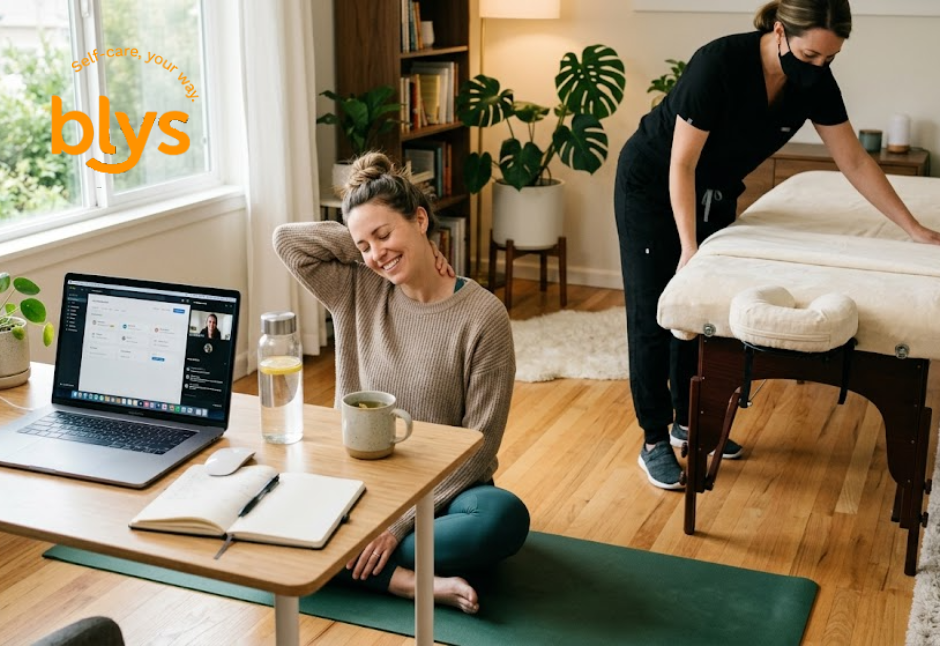
The at-home model flips the equation. Instead of employees traveling to a wellness service, the service travels to them. Through Blys, organizations can provide staff with access to vetted, insured, professional providers massage therapists, physical therapists, sports recovery specialists who come directly to an employee’s home or chosen location at a time that actually works for their schedule.
This changes three things that consistently undermine wellness program participation:
- Geography stops being a barrier: A provider comes to the employee, wherever they are city, suburb, or rural location. There’s no affiliated-facility map, no coverage gap, and no two-tier system where employees in major metros get a real benefit and everyone else gets a wellness portal they never log into.
- Scheduling works around shifts, not clinic hours: Blys operates across evenings and weekends. Bookings are made on demand, so staff schedule sessions when their particular pattern allows not when a clinic happens to have availability.
- Participation becomes the path of least resistance: When a vetted, professional provider arrives at an employee’s door, they don’t have to decide to make the effort. The benefit meets them where they already are. Providers you book through Blys bring all necessary equipment, so there’s nothing to prepare and no travel cost on the employee’s end.
For healthcare organizations and shift-based workforces specifically, this delivery model isn’t an incremental improvement it’s a fundamentally different approach to how employee wellness programs reach the people who need them most.
Where At-Home Employee Wellness Programs Make The Biggest Difference
Not all employee wellness programs fall short in the same way but the teams left behind tend to share one thing in common: their working patterns don’t fit the standard model. Here’s where at-home delivery moves the needle most.
Healthcare Workers And Non-Standard Shift Schedules
Healthcare workers face some of the highest rates of occupational musculoskeletal injury of any professional group in the US. Patient handling, prolonged standing, repetitive clinical tasks, and irregular sleep compounded by the emotional intensity of clinical care create a cumulative load that most standard corporate wellness programs are not built to address.
Here’s the gap in sharp relief: the very nature of healthcare work is what makes access to conventional wellness benefits so difficult. Night shifts, rotating schedules, and mandatory overtime don’t leave room for a Monday lunchtime yoga class or a clinic appointment that closes at 5pm.
Research indexed on PubMed has consistently linked regular soft-tissue and manual therapy with meaningful reductions in musculoskeletal pain, improved sleep quality, and lower self-reported stress in shift workers outcomes that translate directly into fewer sick days and better retention. At-home delivery makes those outcomes accessible to nurses, techs, and allied health professionals on every shift pattern, not just the day staff with standard hours.
Remote And Distributed Organizations
For companies operating with a fully or largely remote workforce remote engineering teams, nationwide sales organizations, consulting firms with staff across multiple states a wellness benefit tied to a physical location is effectively symbolic for the majority of employees. They know it, and it subtly signals that their working situation wasn’t seriously considered when the benefits package was put together.
An at-home employee wellness program through Blys works the same way in Nashville as it does in San Francisco or Bozeman. There’s no geographic disparity in access. Every employee gets a benefit they can actually use.
The business case for this extends beyond utilization rates. Employee appreciation and wellness ideas that land well with distributed teams consistently share one feature: they don’t require everyone to be in the same place. Remote employees who feel their employer has designed benefits around their actual working situation report measurably higher engagement and lower intent to leave.
Logistics, Manufacturing, And Shift-Based Retail
Warehouse workers, distribution center staff, and retail employees carry significant physical loads in demanding environments and they’re rarely the employees who show up in the case studies for corporate wellness programs. On-site facilities don’t exist. Clinic networks cluster around urban centers. And the economics of these industries don’t typically support the premium wellness spend that head-office populations sometimes receive as a matter of course.
The at-home model works well here because it requires zero on-site infrastructure from the employer. Organizations provide platform access, staff book trusted, insured providers independently when they need them, and every dollar of wellness investment reaches an actual employee.
How Do You Roll Out At-Home Wellness As A Company Benefit?
Setting up an at-home employee wellness program through Blys is designed to be operationally simple for HR and benefits teams. The table below outlines the most common approaches and when each works best.
| Implementation Option | How It Works | Best For |
| Wellness Credits / Vouchers | Employer purchases Blys credits that staff redeem for any available service, on their own schedule | Flexible, employee-directed usage with predictable per-head spend |
| Flexible Benefits Integration | Blys sits within a monthly or quarterly wellness allowance as an eligible spend category | Organizations already running a flex-perks or HRA model |
| Group / Team Sessions | Expert providers attend a shared location for a team gathering or company event | Hybrid teams that periodically come together in person |
| Recognition Credits | Credits issued as part of milestone acknowledgment or performance recognition | Rewarding effort in a way that feels personal and genuinely useful |
Getting started is a straightforward process the Blys corporate team helps organizations choose the right structure, handle provider logistics, and build the internal communication that drives awareness and uptake among staff. The platform manages provider matching, scheduling, and payment centrally, so there’s no complex system integration on your end.
To explore what’s available for organizations, including individual employee access, group programs, and custom arrangements, the Blys corporate wellness page is the right starting point.
Stop Leaving Your Hardest-Working Employees Out Of Your Wellness Strategy
The goal of any employee wellness program is straightforward: support the people doing the work. But when the delivery model only reaches a subset of those people the office-based, the urban, the standard-hours workers the investment delivers only a fraction of its potential return. And the employees it misses tend to be the ones carrying the heaviest loads.
At-home delivery doesn’t require a complete overhaul of what your wellness program offers. It requires a change in how the benefit reaches people. When vetted, professional providers go to your employees wherever they are, whenever their schedule opens up the access barriers that make so many employee wellness programs underperform stop being relevant.
If your program isn’t reaching your shift workers, your remote team, or your distributed workforce, the delivery model is most likely the bottleneck. The right benefit, delivered in the right way, reaches everyone.