Demand for in-home prenatal massage has been rising steadily across the US and it’s not hard to understand why. Getting to a spa or clinic in the third trimester takes real effort. Finding parking near a treatment room can add 20 minutes to a 60-minute appointment. And lying face-down on a standard table is simply not appropriate for most of pregnancy. As a mobile prenatal massage therapist, you’re not just a convenient option. You’re often the only practical one.
This guide is for massage therapists who want to build or expand a mobile prenatal and postpartum practice. We cover the equipment that actually works in a home setting, how licensing and insurance requirements apply to mobile work, how to handle pre-session communication with prenatal clients, and how Blys connects professional mobile therapists with clients who are actively looking for at-home services.
If you’re earlier in your career planning, the prenatal massage therapist career guide covers training and scope of practice before the operational detail below.
What Equipment Does A Mobile Prenatal Massage Therapist Actually Need?
Your mobile kit needs to do more than travel well. It needs to make side-lying work safe, effective and comfortable in whatever space a client can clear for you.
Portable Table And Prenatal Positioning
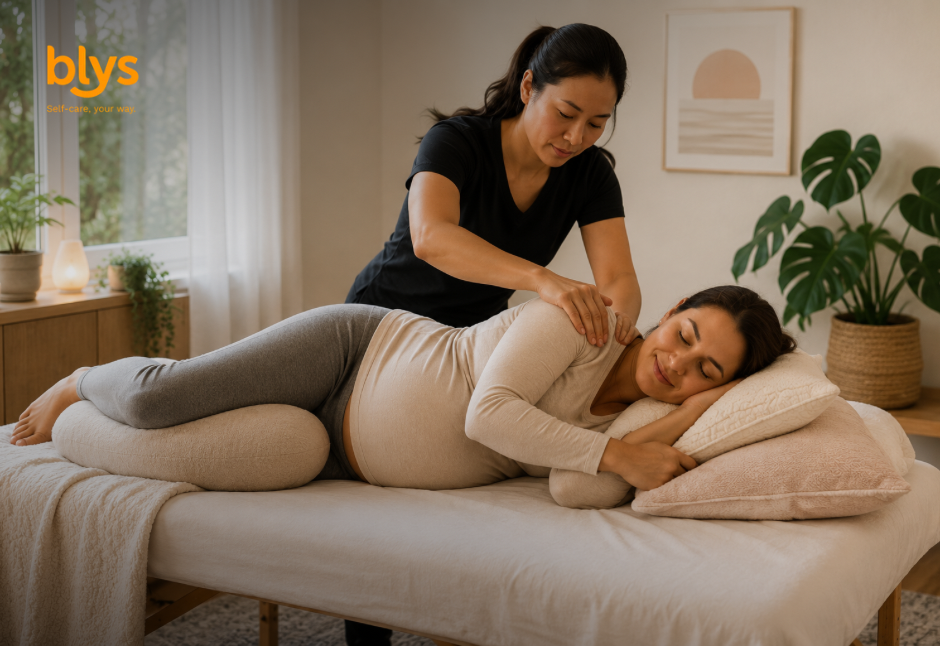
Choose a folding table that is lightweight (under 30 lbs is a practical target), sturdy under pressure, and fits in a standard car trunk. For prenatal massage, a proper side-lying bolster system is essential not optional. A complete set typically includes a full-length body pillow or wedge bolster, a pillow for between the knees, and ankle support.
Be cautious of tables marketed with a prone “pregnancy cut-out.” Positioning a prenatal client face-down places pressure on uterine ligaments and is generally contraindicated from the second trimester onward. Side-lying is the evidence-based standard, and a good bolster system makes it genuinely comfortable.
The Rest Of Your Travel Kit
Beyond the table and bolsters, a few essentials round out a professional mobile kit each one earns its place on every visit:
- Unscented or lightly fragranced massage oil. Several essential oils are contraindicated in pregnancy; an unscented base oil is a safe default until you know the client’s preferences.
- Extra sheets and a waterproof table cover.
- A bolster bag or integrated carry case so set-up is fast and professional.
- A pre-session health intake form covering gestational age, risk classification, and relevant medical history sent in advance, not completed on arrival.
Aim for a professional, clean setup in under 10 minutes. Clients notice when a therapist arrives prepared. A tidy, well-organised kit sets the tone before the session has even started.
Do Mobile Prenatal Massage Therapists Need Licensing And Insurance In The US?
Licensing requirements for massage therapists vary by state. Most states require licensure through the National Certification Board for Therapeutic Massage & Bodywork (NCBTMB) or equivalent state-level boards, with continuing education requirements that vary significantly. Before offering mobile services, confirm your state license is current and covers mobile practice some states have specific language around in-home sessions.
For insurance, professional liability (also called malpractice insurance) is standard practice for any working massage therapist. For mobile prenatal massage, you also need public liability coverage for third-party property damage. When you’re working in a client’s home, you’re responsible for what happens to their space.
Before your first mobile prenatal booking, confirm your policy explicitly covers:
- Prenatal and postpartum massage (some policies carry explicit exclusions for these client groups)
- In-home and mobile sessions
- Public liability for property damage occurring during a session
Organizations like the American Massage Therapy Association (AMTA) and Associated Bodywork and Massage Professionals (ABMP) both offer liability coverage packages that are widely used in the profession. A study on prenatal massage outcomes published via PubMed highlights the real clinical benefits of the work proper coverage means you can deliver those benefits with full professional confidence.
Providers who list on Blys go through a vetting process that checks for current insurance and credentials before they’re approved to take bookings.
How Should You Communicate With Prenatal Clients Before A Mobile Session?
Pre-session communication is where professional mobile practice is built and where risks are managed before they become problems.
Health screening before arrival. Send a detailed intake form ahead of the appointment. You need to know gestational age, whether the pregnancy is classified as high-risk, and whether there is any history of preterm labor, placenta previa, preeclampsia, DVT, or clotting issues. If anything flags, the appropriate step is to consult with the client’s OB-GYN or midwife before proceeding.
Research consistently supports the value of prenatal massage a study published on PubMed found meaningful reductions in anxiety and leg pain with regular prenatal massage. Thorough screening is what connects that evidence to safe, confident practice.
Sort the logistics beforehand. Ask whether the client can clear a suitable space (approximately 10 x 6 feet of floor space), whether stairs are involved for carrying your table, and whether pets need to be contained. Clients consistently respond positively to this level of preparation it signals that you know what you’re doing.
Postpartum sessions work differently. Most postpartum clients can receive massage from around six weeks after a vaginal birth with healthcare provider clearance. Clients who have had a C-section should always confirm the appropriate timeline with their provider. Postpartum clients often have interrupted sleep and limited scheduling windows, so keep post-session communication efficient and rebooking simple.
How Does Blys Help Mobile Therapists Build A Prenatal Massage Client Base?
Building a mobile prenatal massage practice from scratch takes time. Prenatal clients and postpartum clients returning to self-care are selective about who they invite into their homes. Trust and vetted professionalism are the deciding factors, ahead of price or proximity.
Blys is a booking platform that connects vetted, insured mobile massage professionals with clients searching for at-home services. For therapists on the platform, this means access to clients who are already actively looking for mobile prenatal massage without needing to build a website from scratch, run paid ads, or generate reviews as a first step.
Unlike going fully independent from day one, providers you book through Blys are already operating within a framework clients trust. The platform handles scheduling, payment infrastructure, and the credibility signals that matter to first-time bookers. You focus on delivering great work and building lasting client relationships.
To see what this looks like financially, the prenatal massage therapist salary guide covers how rates compare across mobile and clinic-based work. And the prenatal massage service page shows exactly how Blys presents this service to clients which tells you a lot about what they’re searching for.
How To Reach Clients Already Looking For Mobile Prenatal Massage
Mobile prenatal massage is one of the strongest growth areas in the massage profession right now and demand for professional, insured therapists genuinely set up for home visits consistently outpaces supply.
The equipment, licensing, insurance, and client communication are your professional foundations. Getting consistent bookings is the next layer. If you’re ready to build your mobile prenatal and postpartum client base, joining Blys as a provider connects you with clients already looking for what you offer.