 Football is a sport that asks a lot from your body week after week, season after season. With the 2026 FIFA World Cup coming to the United States, soccer has never had a bigger moment in this country, and the conversation around how players train, recover and stay healthy is front and center.
Whether you play competitive club soccer, turn out for a recreational league on weekends or are simply inspired by the world’s best athletes performing at their peak, the tools they rely on are more accessible than you might think. Sports massage has moved from the professional locker room into everyday training culture, and for good reason.
This post covers why football and soccer players benefit from it, when to use it and how to fit regular sessions into your week without adding more to an already full schedule.
Why Football And Soccer Players Put Their Bodies Under Serious Stress
Outfield players typically cover 10 to 13 kilometers in a single match, with repeated short sprints, sharp directional changes and physical contact compressed into 90 minutes. When you add training sessions throughout the week, the cumulative load on muscles, tendons and joints becomes significant particularly over a long season.
The areas that take the most punishment include:
- Hamstrings and hip flexors overloaded during sprinting and kicking
- Calves and Achilles tendons stressed by explosive acceleration and sudden stops
- Quadriceps and IT band under strain from sustained running and lateral movement
- Glutes and lower back fatigued by the rotational demands of the sport
Left unaddressed, this repetitive stress accumulates. Muscle fibers develop micro-tears, metabolic waste builds up in the tissue and flexibility quietly decreases all of which increase your risk of the non-contact muscle injuries that sideline soccer players at every level.
This is where sports massage comes in. Research published on PubMed consistently shows that soft tissue therapy reduces delayed onset muscle soreness (DOMS) and supports faster perceived recovery after high-intensity exercise.
By working directly through the tissue, sports massage helps clear metabolic waste, restore circulation and reduce the neural tension that keeps muscles feeling tight long after you’ve left the field.
Pre-Match Vs Recovery Sessions: Knowing Which One Your Body Needs
Not all sports massage sessions serve the same purpose. Timing matters, and so does the approach. Book the wrong type at the wrong point in your week and you could walk onto the field feeling sluggish or miss the recovery window where your body needs it most.
Getting Ready To Play: The Pre-Match Session
A pre-match massage is shorter typically 20 to 30 minutes and uses lighter, faster techniques designed to activate and warm the tissue rather than release it deeply. The goal is to stimulate blood flow, improve neuromuscular responsiveness and help your body shift into a ready state before the opening whistle.
Techniques like effleurage and tapotement keep the session energizing rather than sedating. Deep tissue work has no place here. Done well, a pre-match session sharpens your physical readiness without leaving you feeling heavy or flat and because you can book a provider through Blys to come to your home, there’s no travel to factor into your preparation on game day.
After The Final Whistle: The Recovery Session
Recovery sessions are where most football and soccer players see the greatest long-term benefit. Scheduled in the 24 to 72 hours after a match or hard training session, a recovery-focused sports massage targets:
- Residual muscle soreness and tightness
- Circulation in fatigued tissue to support faster repair
- Tension in areas that absorb effort quietly the lower back, glutes and hip flexors
- Early signs of overuse that, if ignored for weeks, develop into real injuries
The pressure is deeper and the pace is slower than pre-match work. A skilled provider will typically work through the posterior chain calves, hamstrings, glutes, lower back before addressing the quads and hip flexors. A full session often includes the upper back and shoulders, which matter more than most soccer players realize given the demands of aerial challenges and physical play.
This is also where the at-home model genuinely earns its place. After a Saturday afternoon match, most players are tired and not particularly motivated to drive across town. Booking recovery to come to you means it actually gets done rather than getting pushed to next week.
What A Mobile Sports Massage Session Looks Like After A Game
If you’ve never booked an at-home sports session before, the format is straightforward.
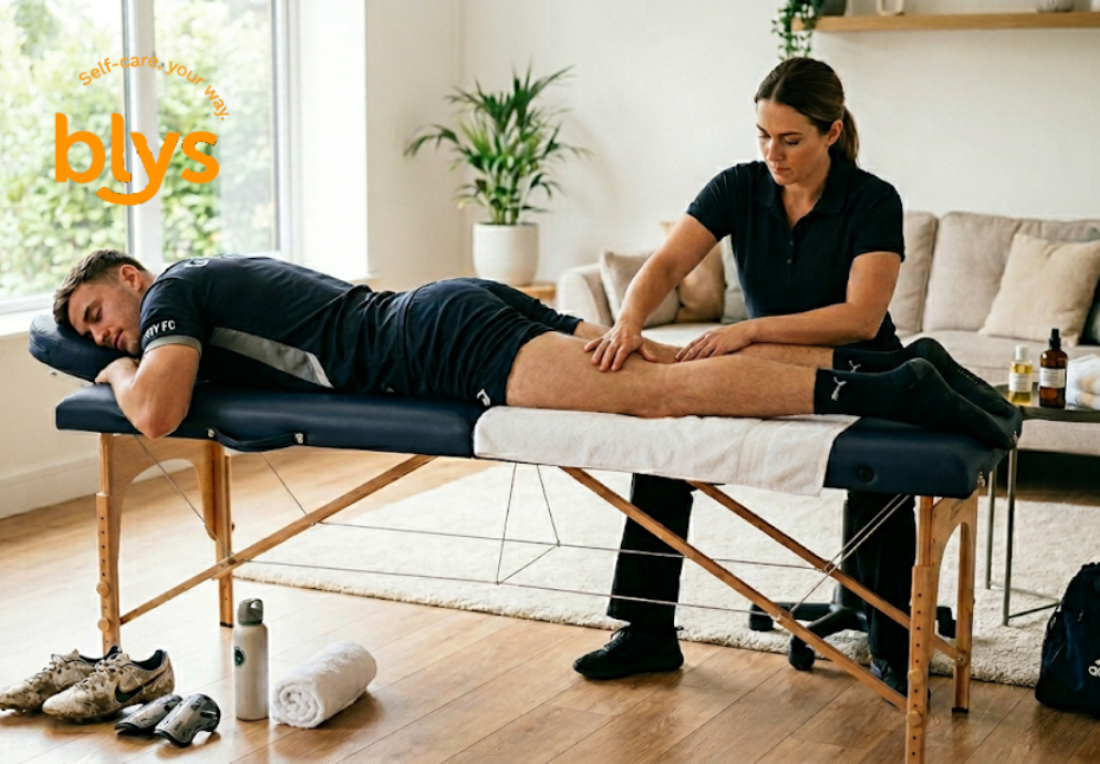
When you book a sports massage through Blys, you’re matched with a vetted, insured professional from the booking network. They arrive with a portable massage table and everything needed for the session you don’t need to prepare anything beyond a clear space and a few minutes to talk through where your body is at.
Before the session starts, a good provider will ask about recent training load, any areas of concern and what you want to get out of the session. This matters. A recovery session two days after a grueling pre-season double is very different from a mid-season maintenance session, and a knowledgeable provider will treat them accordingly.
A typical 60-minute recovery session for a soccer player might cover:
- Calves and Achilles: 10 to 15 minutes
- Hamstrings and glutes: 15 minutes
- Quads and IT band: 10 minutes
- Lower back and hips: 10 minutes
- Upper back and shoulders: 5 to 10 minutes
After the session, you’ll likely be advised to hydrate well, keep movement gentle for the rest of the day and apply heat or ice to specific areas as needed. Most players report sleeping significantly better that night which itself plays a major role in muscle repair and recovery from training load.
How Sports Massage Helps Prevent Injuries Across A Season
Most soccer injuries don’t arrive without warning. They build. A hamstring that’s been tight for three weeks. A hip flexor that keeps nagging in the final 20 minutes. A calf that cramps every time it’s cold out. These are early warning patterns and an experienced sports massage provider is trained to spot and address them before they become a real problem.
Research says that the role of regular soft tissue work in reducing non-contact muscle injuries in team-sport athletes. The mechanism is straightforward: well-maintained muscle tissue has greater extensibility, better blood supply and improved neuromuscular responsiveness all of which reduce the likelihood of a sudden strain or tear when your body is pushed hard.
For soccer players, this makes sports massage a practical investment in staying on the field, not just feeling better for a day or two. The question most players have is how often. That depends on your training load, injury history and where you are in the season. For a closer look at timing and cadence, this sports massage frequency guide breaks it down by athlete type and training phase.
As a general starting point:
- Mid-season competitive players: one session every two weeks covers most needs
- Pre-season or heavy game runs weekly sessions are often worthwhile
- Recreational and social players: even monthly sessions make a noticeable difference to how you feel on game day
Not sure where to start? A provider you book through Blys can assess your training load in the first session and help you figure out a schedule that actually fits your life no guesswork required.
Why Booking At Home Changes The Math On Recovery
Here’s something most performance guides don’t address: the biggest barrier to consistent sports massage for most players isn’t cost or knowledge it’s friction.
After a hard match or training session, you’re tired. Driving to a clinic, finding parking and waiting for an appointment adds time and effort to an already depleted evening. For most players, the session gets skipped not because they don’t believe in it, but because the path of least resistance is simply to go home and rest on the couch.
Booking through a platform like Blys removes that barrier entirely. You schedule the session for a time that works Sunday morning, a post-training evening mid-week and a trusted, local provider arrives at your door with everything needed. No commute, no waiting rooms, no rearranging the rest of your day around a clinic appointment.
This matters because consistency is what makes sports massage effective. A single session delivers short-term relief. A regular program of recovery work aligned to your training load and the demands of your season is where the real performance and longevity gains stack up over time.
If you want to understand exactly what that looks like for an active athlete, this breakdown of sports massage benefits covers the research and practical outcomes in detail.
Getting Your Body Ready For Match Season
With the 2026 World Cup being hosted right here in the United States, soccer is having its biggest moment in American sports culture in a generation. Whether you’re competing at a high level or just trying to stay healthy and consistent through a recreational season, sports massage is one of the most direct and evidence-backed recovery tools available to you.
The combination of reduced soreness, better tissue health and fewer nagging injuries adds up match after match, season after season. If you’ve been putting it off because booking a clinic session feels like too much effort after a long game day, the at-home model through Blys makes it genuinely easy.
Browse vetted, insured providers in your area, pick a time that fits your schedule and let the recovery come to you.