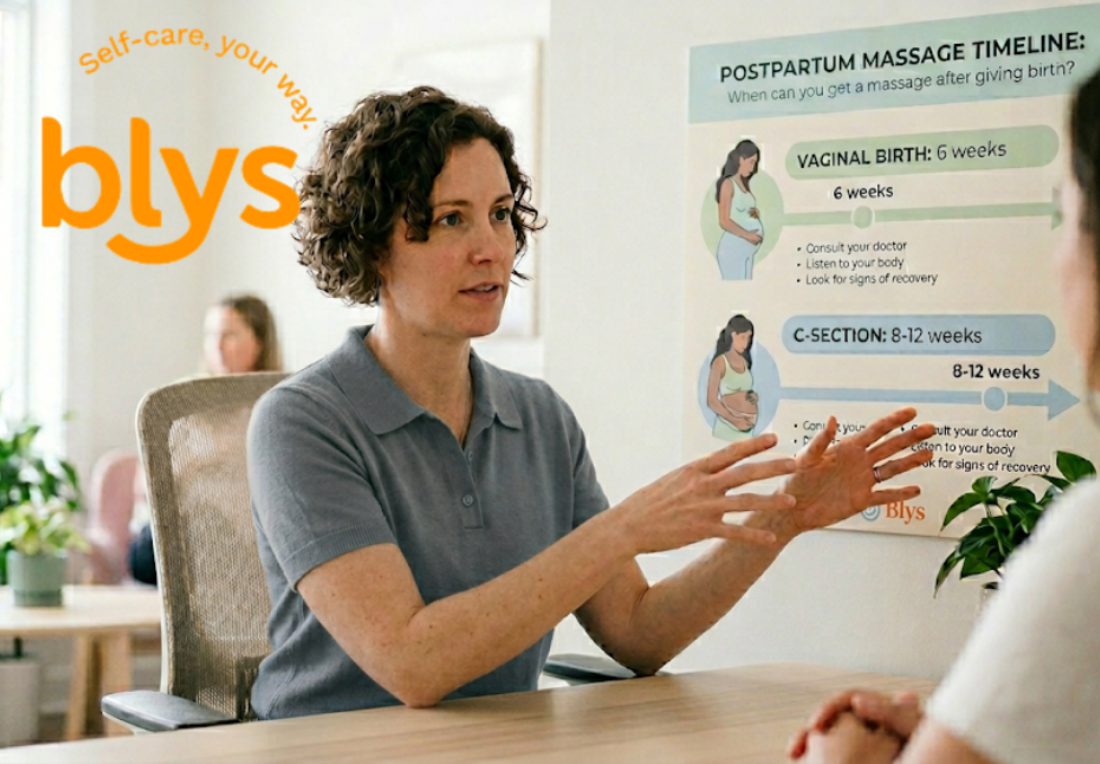
 Your body has just done something remarkable. And now, somewhere between the broken sleep and the constant feeding schedule, you’re asking yourself, ‘When can you get a massage after birth?’ It’s one of the most common questions new moms have in those early weeks and one of the most important to get right.
Postpartum massage can genuinely support recovery, ease the muscle tension that builds from nursing and carrying a newborn, and help you feel more like yourself again. But the timing matters, and what’s appropriate depends significantly on how your birth went.
This guide covers both vaginal birth and cesarean section timelines clearly, walks through what’s generally safe at two, four, and six weeks postpartum, and explains what to avoid during early recovery. We’ll also cover something most guides miss entirely: why getting yourself to a studio in those first weeks is far harder than it sounds and how at-home massage changes that completely.
Nothing here replaces advice from your OB-GYN or midwife but this gives you a solid foundation before that conversation.
After a Vaginal Birth: How Soon Is It Safe?
For most people who’ve had an uncomplicated vaginal birth, gentle postnatal massage can begin within the first one to two weeks. That’s genuinely encouraging news for a body carrying significant tension, hormonal change, and fatigue in those first days.
“Uncomplicated” carries a lot of weight in that sentence, though. Even a smooth vaginal birth involves enormous physical stress: hormonal shifts, significant fluid changes, and in many cases perineal tearing or an episiotomy that needs time to close before any pressure near the area is appropriate.
Three things shape the safe starting point after a vaginal birth. First, wound healing if you had stitches from a tear or episiotomy, those need adequate time to close before any pressure near the perineum or inner thighs is appropriate. Second, fluid balance your body is actively rebalancing after pregnancy, making deep-pressure techniques unsuitable at this stage.
A gentle, Swedish-style relaxation session focused on the back, shoulders, neck, and upper legs is a far better starting point. Third, lochia postpartum bleeding and discharge can continue for up to six weeks, so strong circulatory stimulation in the abdominal area should be introduced gradually rather than in the earliest weeks of recovery.
For most people without complications, a session focused on the upper body back, shoulders, neck, exactly where new parents carry the most tension from nursing, carrying, and disrupted sleep is generally considered safe from around one to two weeks postpartum. Always confirm with your OB-GYN or midwife before booking.
One practical reality worth naming: in those early weeks, getting to a studio may simply not be realistic. Between feeds, recovery, and a newborn on no one’s schedule, leaving the house for an appointment can feel like an impossible ask.
This is exactly where booking through a platform like Blys changes things. A vetted, insured professional comes to your home, so you access the support your body needs without transport, timing pressure, or added logistics.
After a C-Section: Why the Timeline Changes Significantly
A cesarean section is major abdominal surgery. That distinction is critical when it comes to postpartum massage timing, because what’s happening beneath the surface during recovery is substantially more complex than the visible incision suggests.
Most practitioners recommend waiting at least six weeks before any massage work near the abdominal area following a C-section. The scar you can see is only the outermost layer multiple internal tissue layers go through a staged healing process that isn’t visible from outside, and deep pressure applied too early can interfere with that.
What’s Appropriate Before Six Weeks?
While the abdomen is off-limits in the early weeks, gentle massage on other parts of the body can often begin from around two to three weeks post-surgery, assuming recovery is progressing without complications.
The back, shoulders, neck, and legs are generally appropriate to work on sooner. Positioning is a key consideration lying face down will not be comfortable or appropriate in the early stages of cesarean recovery. Experienced, professional providers adapt using cushions and side-lying techniques to keep sessions safe and comfortable.
A practical note: most physicians advise against driving for four to six weeks following a cesarean. That alone can make getting to a studio genuinely impossible. If transport is a real barrier, the providers you book through Blys come to your door no car required, no additional stress.
Should You Consider Scar Massage Later?
Once the incision has fully healed typically between 8 and 12 weeks postpartum, though this varies gentle scar tissue mobilization can be a valuable addition to recovery.
Research published via PubMed supports the use of scar massage for improving long-term comfort, sensation, and mobility following cesarean births. Discuss this with a physical therapist or your OB-GYN before starting this isn’t something to introduce without professional guidance.
What’s Generally Safe at 2, 4 and 6 Weeks Postpartum?
If you’re trying to figure out where you are in your recovery timeline, this table gives a clear picture of what’s generally appropriate at each milestone and how that changes depending on how you gave birth.
| Milestone | After a Vaginal Birth | After a C-Section |
| 2 weeks | Gentle relaxation massage on the upper body and legs is often appropriate. Deep pressure and abdominal work are not. Check with your OB-GYN or midwife first. | Abdomen is completely off-limits. Upper body work may be fine with adapted positioning. Confirm with your doctor before booking. |
| 4 weeks | A broader session is generally appropriate back, shoulders, legs. Deep abdominal work is still not recommended at this stage. | Still within the incision healing window. Avoid the abdomen entirely. Upper and lower body work may be appropriate. |
| 6 weeks | A wider range of techniques is usually appropriate by now. Use your six-week postpartum check-up to confirm what’s right for your recovery. | Surface healing may be complete, but scar tissue work is typically still too early. Discuss this specifically with your OB-GYN at your check-up. |
Your six-week postpartum visit with your OB-GYN or midwife is the ideal time to ask specifically about massage what type is appropriate, and whether any areas need to be avoided based on your own recovery.
Which Types of Massage Should You Avoid in Early Postpartum Recovery?
Not every massage technique is suitable in the weeks after birth and some that are perfectly appropriate in other contexts are genuinely not safe during early recovery.
Here’s what to steer clear of:
- Deep tissue massage on the abdomen: The uterus is still involuting contracting back to its pre-pregnancy size for the first several weeks. Deep abdominal pressure is not appropriate until well into recovery, and an experienced professional will know this without being prompted.
- Hot stone massage: Significant heat increases circulation, which can be counterproductive when the body is still managing fluid balance and early healing. This is much better suited to a later stage of recovery.
- Strong essential oils: Some aromatherapy oils are contraindicated during breastfeeding. If you’re nursing, ensure any oils used are safe for lactating women and let your provider know upfront before the session starts.
- Lying face down: Depending on your stage of recovery, this may not be comfortable or appropriate. Any insured, experienced provider will ask before beginning and adapt accordingly.
- Any technique that causes pain: Postpartum massage should not hurt. Anything beyond mild muscular release is a clear signal to stop and reassess. A good provider checks in throughout and adjusts without hesitation.
When Should Your OB-GYN or Midwife Weigh In Before You Book?
Postpartum massage is broadly supported as beneficial for recovery but there are specific situations where medical clearance first is genuinely important.
Speak to your OB-GYN or midwife before booking if you:
- Had a complicated birth or required significant medical intervention.
- Are showing signs of infection fever, unusual redness, warmth, or discharge.
- Have been diagnosed with, or are at elevated risk of, deep vein thrombosis (DVT).
- Are managing postpartum hypertension or preeclampsia.
- Had a C-section within the past four to six weeks and want any massage near the incision site.
- Are uncertain about any aspect of your recovery.
The National Institutes of Health underscores the importance of individualized care in the postpartum period, particularly when underlying health factors are involved. Seeking clearance isn’t overcaution it’s making sure the massage you receive supports your recovery rather than complicating it.
It’s worth reading up on what to expect before your first session too. Our guide on the benefits of pregnancy massage covers a great deal of the relevant research, what to expect from a pregnancy massage explains how sessions are typically structured, and is pregnancy massage safe? addresses safety considerations that apply directly to early postnatal recovery.
Why Most New Moms Can’t Easily Get to a Studio And What to Do Instead
Here’s what most postpartum massage guides skip over entirely.
Knowing when you can have a massage is one thing. Getting yourself to a studio or spa during those first weeks of recovery is a completely different challenge and one that ends up pushing the whole idea off indefinitely for a lot of new moms.
After a C-section, you may not be cleared to drive for four to six weeks. If you’re nursing on demand, your schedule is unpredictable and feeds are frequent. If your newborn only settles when held, arranging a studio appointment and actually getting there can feel completely unworkable, even when you know the massage would help.
This is why at-home postpartum massage isn’t just a convenient upgrade. For many new moms, it’s the only format that makes access to recovery support genuinely possible in those early weeks. And it’s the precise gap that Blys was built to fill: bringing expert, insured professionals directly to your door at a time that works around feeds, sleep, and the unpredictable rhythm of life with a newborn.
When you book through Blys, there’s no driving, no arranging childcare, and no working around a studio schedule. When the session ends, you’re already home able to rest and recover without a return trip undoing the work.
he providers you book through Blys are experienced professionals who understand how to adapt postnatal sessions: appropriate positioning, the right pressure, and a clear understanding of what to avoid at each stage of recovery.
Explore what postnatal recovery support looks like through pregnancy massage services on Blys, or find trusted, local professionals available near you on the Blys platform.
Getting Clear on Your Postpartum Massage Timing
There’s no single answer to when postpartum massage is safe it depends on how you gave birth, how recovery is progressing, and what your healthcare provider advises. For most people after an uncomplicated vaginal birth, gentle massage from one to two weeks is a reasonable starting point. After a C-section, six weeks is the general minimum before any work near the abdomen.
Get clearance from your OB-GYN or midwife first. Then find a vetted, insured professional who genuinely understands postnatal work. Those two things together make a real difference.
And if leaving the house right now feels like too much? That’s completely valid. Explore at-home massage through Blys and have a trusted professional come to you, when your body is ready, on your schedule.