 Nurse burnout is one of the most critical workforce crises in American healthcare right now and the numbers are hard to ignore. Across hospitals, long-term care facilities, and community health settings, experienced nurses are leaving the profession in record numbers. Not because they stopped caring. Because the conditions that allow sustained, excellent care have been pushed past their limits.
If you’re a nurse, this isn’t abstract data. You know what it feels like to finish a 12-hour shift with nothing left for anyone including yourself. You know the math of running short-staffed on a busy unit, the emotional load that never shows up on a job description, and the physical toll of a schedule that rotates so often your body can’t find any rhythm.
Here’s what most wellness content misses for people in your position: the advice assumes you have predictable evenings, energy after a long shift, and access to services that are actually open when you’re free. For nurses on rotating 12-hour shifts, none of that holds. The recovery options that work are the ones that come to you at home, on demand, and scheduled around your actual roster rather than an imaginary one.
What Is Nurse Burnout, And Is That What You’re Actually Experiencing?
Nurse burnout is a state of chronic physical and emotional exhaustion that builds when the sustained demands of patient care consistently exceed your capacity to recover. The World Health Organization classifies it as an occupational phenomenon, a condition produced by working conditions, not a personal failing or lack of dedication.
It shows up in three recognizable ways. Emotional exhaustion: the feeling of being completely drained, nothing left to give. Depersonalization: emotionally distancing from patients and coworkers as a self-protective response when you’re running on empty. And a reduced sense of personal accomplishment work that once felt deeply meaningful starts to feel like going through the motions.
This is worth separating clearly from having a bad stretch. Every nurse has hard weeks. Nursing burnout is what happens when the hard weeks don’t stop when rest stops feeling restorative, when you start dreading your next shift rather than feeling ready for it.
A landmark study from the American Nurses Foundation found that more than half of US nurses reported experiencing burnout during and following the COVID-19 pandemic. The profession was already under significant strain before 2020; the pandemic accelerated an existing trajectory. If this resonates, you are not alone and you are not the problem.
Why Are American Nurses Burning Out? The Real Causes Behind the Exhaustion
The causes of nursing burnout in the US are structural, not personal. Research from peer-reviewed health journals consistently identifies the same conditions:
- Inadequate staffing and unsafe patient ratios: Being responsible for more patients than is clinically safe turns every shift into sustained crisis management with no room to breathe.
- 12-hour and rotating shifts: While popular for scheduling flexibility, 12-hour shifts compress recovery time, and rotating schedules disrupt circadian rhythms, sleep quality, and social connection in ways that compound over years.
- Emotional labor: Sitting with patients and families through fear, pain, grief, and trauma is profoundly demanding work that rarely appears in staffing models or workload metrics.
- Moral injury: Being required to ration care because of resource constraints, or follow protocols you believe are harming patients, creates a distinct and serious form of psychological distress.
- Limited professional autonomy: Nurses who feel they have no meaningful input into their working environment or clinical decisions are at significantly higher burnout risk.
- Lack of recognition: When experienced nurses aren’t acknowledged for their contribution, the intrinsic drive that sustains care work erodes.
- Toxic workplace culture: Poor management, team dysfunction, and environments that lack psychological safety accelerate burnout across entire units.
Recognizing these as structural causes not character deficits matters for how you approach the response. It means advocating for better conditions while also protecting your own wellbeing in the meantime.
Does Your Burnout Affect Your Patients? Here’s What the Research Actually Shows
Nurse burnout is simultaneously a worker health crisis and a patient safety issue. The research on this is consistent and direct.
Studies have linked burnout in clinical nurses to increased rates of medication errors, greater susceptibility to hospital-acquired infections, reduced responsiveness to patient deterioration, and lower overall patient satisfaction scores. When you’re operating in a state of chronic depletion, the cognitive capacity required for safe clinical decision-making is genuinely reduced not as a performance issue, but as a physiological one.
In the US, the costs extend well beyond individual patient encounters. The nursing shortage significantly driven by burnout-related attrition places greater burden on remaining staff, which accelerates further burnout in a cycle that’s difficult to interrupt without structural change. The American Hospital Association has flagged nursing workforce sustainability as one of the defining healthcare challenges of the coming decade.
This isn’t meant to pile more on an already overloaded plate. It’s here to make one thing clear: your recovery matters not as a luxury, but as a prerequisite for the care you’re there to provide and your capacity to keep providing it long term.
What Does Self-Care Actually Look Like on a 12-Hour Rotating Schedule?
Generic wellness advice is designed for generic schedules. If your shift starts at 19:00, ends at 07:30, or varies week to week, most standard recommendations simply don’t apply.
Here’s what actually can:
- Micro-recovery between shifts: 15 to 20 minutes of genuine intentional rest (not phone scrolling) engages the parasympathetic nervous system and meaningfully supports faster physical recovery. Guided breathwork takes five minutes and works anywhere including a parked car before driving home.
- Meal prep on your days off: Removing nutrition decisions from the post-shift window eliminates a daily source of depletion. High-protein, grab-ready food keeps energy stable across 12-hour shifts without requiring any effort at 6am.
- Home-based movement: Walks, bodyweight training, and stretching at home require no membership, no commute, and no fixed schedule. Consistency at a level you can actually sustain beats intensity that requires more than you have to give.
- Sleep optimization for rotating shifts: Blackout curtains, a consistent pre-sleep routine, a cool and quiet space, and phone-free wind-down time all meaningfully improve sleep quality even when the timing shifts week to week.
- At-home physical recovery: Booking a vetted, insured professional to come directly to your home removes every barrier that makes clinic-based wellness unrealistic after a long shift. No driving. No waiting rooms. No scheduling around clinic hours that close before your shift ends.
- Scheduled social connection: Time with people who understand healthcare whether coworkers or close friends provides emotional processing that individual self-care can’t fully replicate. Put it in the calendar intentionally rather than waiting for a good moment.
For healthcare employers and clinical managers looking to build meaningful wellness support into their team culture, at-home and flexible formats remove the access barriers that prevent shift workers from engaging with traditional programs.
Why the Clinic Model Fails Shift Workers And What Actually Works
Most wellness services were designed around the assumption that people work Monday through Friday and are free by early evening. Massage clinics close at 6pm. Physical therapy books out weeks in advance. Fitness studios run timetables that assume you’re free at the same time every week.
For nurses on rotating 12-hour shifts, this creates a consistent access problem. But here’s the part most self-care guides miss: it’s not just the hours. It’s the advance booking problem. When your schedule changes week to week, you often can’t commit to a Thursday appointment you booked three weeks ago because you might not know you’d be on a day shift until days before. The traditional clinic model requires forward certainty that shift work doesn’t provide.
Providers you book through Blys can be booked same-day or next-day. That means you can schedule a recovery session once you actually know your shifts not in advance of a schedule that hasn’t been posted yet. It’s a fundamentally different model, and for nurses on rotating patterns, it’s the only one that works in practice rather than in theory.
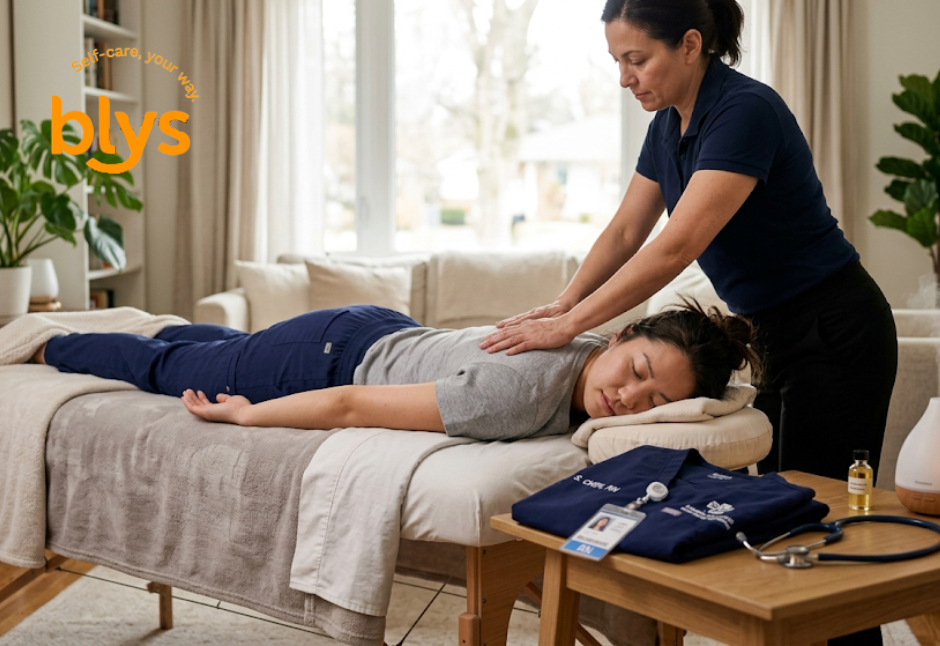
Through Blys, you can access a network of vetted, insured professionals massage therapists, physical therapists, and other expert wellness practitioners who come to your home at whatever time works for you. You recover in your own space, without commuting, without waiting, and without needing to have planned it weeks out.
Building in a planned recovery window before a demanding stretch is one of the most proactive things you can do to stay ahead of exhaustion rather than chasing it.
Take Care Of Yourself So You Can Keep Caring For Others
Nursing burnout is a serious occupational health issue not a personal shortcoming, and not something that gets better by enduring more of the same. The structural forces driving it across US healthcare are real and require collective action. In the meantime, building recovery habits that actually fit your life is one of the most effective things you can do for your patients, your team, and your own ability to keep doing work that matters.
Explore what at-home wellness looks like in your area through Blys and start with whatever fits your next week of shifts.